RSG 3-D's non-combustible panel system offers a financially competitive alternative to conventional construction that delivers wildfire, earthquake, and hurricane resilience.
The federal government's retreat from climate adaptation has created a gap in data, funding, and coordination, but a new decentralized ecosystem of nonprofits, state governments, and coalitions is stepping up to fill the void and may prove more resilient to political disruption in the long run.
As federal disaster support shrinks, resilience districts offer local governments a promising new financing tool to fund climate adaptation on their own terms.
In just a few hours, a severe storm can cause billions worth of damage. Three levers offer opportunities to enhance resiliency and reduce the costs of severe storms: 1) Invest in more resilient roofing; 2) Adopt more resilient construction practices; 3) Invest in new innovations and technologies.
PART 2: This is Part II in a two-part briefing on severe storms. In Part I, we deconstructed the drivers making severe storms so costly. In Part II below, we outline the levers that present opportunities to reduce the impacts and costs of severe storms.
In just a few hours, a severe storm can cause billions of dollars worth of damage. There is no silver bullet to reduce the costs of such storms, but there are a number of ways that asset owners, private sector investors, and companies can ensure their assets stand the best chance.
The following three levers offer opportunities for the private sector to enhance resiliency and reduce the costs of severe storms:
Invest in more resilient roofing
Adopt more resilient construction practices
Invest in new innovations and technologies
Lever #1: Fortify Existing Assets
Fortifying existing assets starts with stronger roofs. The majority of the costs from severe storms are due to hail, and the vast majority of hail damage occurs on roofs, according to Ian Giammanco, lead meteorologist at the Insurance Institute for Business and Home Safety (IBHS).While hail and high winds impact the built environment differently, many of the same fortifications can make structures more resilient to both hazards.
Traditional roofs in hail-prone areas last half as long (10 years vs. 20 years, on average) because they need to be replaced more frequently. This doubles the cost to homeowners and insurance companies over the same period of time. With the average cost of a roof in the U.S. at approximately $10,000, insurance companies are paying an average of 2x that cost over 20 years for roofs in areas that receive frequent hail.
One way to fortify roofs against damages from severe storms is to replace existing roofs with impact-resistant roofing–roofing that’s made from similar materials as existing roofing (plastic, resin, asphalt, tiles, or metal), but fortified to be more resistant to hail impacts. Across the roof rating classes, Class 4 impact-resistant shingles are the least prone to damage. The average impact-resistant roof could last 60% longer than traditional roofs (30-50 years with impact-resistant shingles, as compared to 15-30 years for a well-maintained asphalt shingle roof). Increasingly, companies like Malarkey, Owens Corning, and Certainteed are producing impact-resistant roofing.
The repeated replacement of unfortified roofs has led insurance companies to experiment with new models and incentives for homeowners. In some states like Oklahoma, insurance companies can reduce home insurance premiums by up to 42% if people install impact-resistant roofing. In Colorado, homeowners can save 28% on premiums by installing impact-resistant roofing.
Lever #2: Adopt More Resilient Construction Materials and Practices
More resilient construction materials and practices can ensure a structure withstands a severe storm. There are multiple business and investment opportunities in new construction and renovations. Beyond just roofing, impact-resistant materials can be found throughout the home: from concrete framing to strong exterior sheathing on the sides of homes to impact-resistant windows and garage doors.
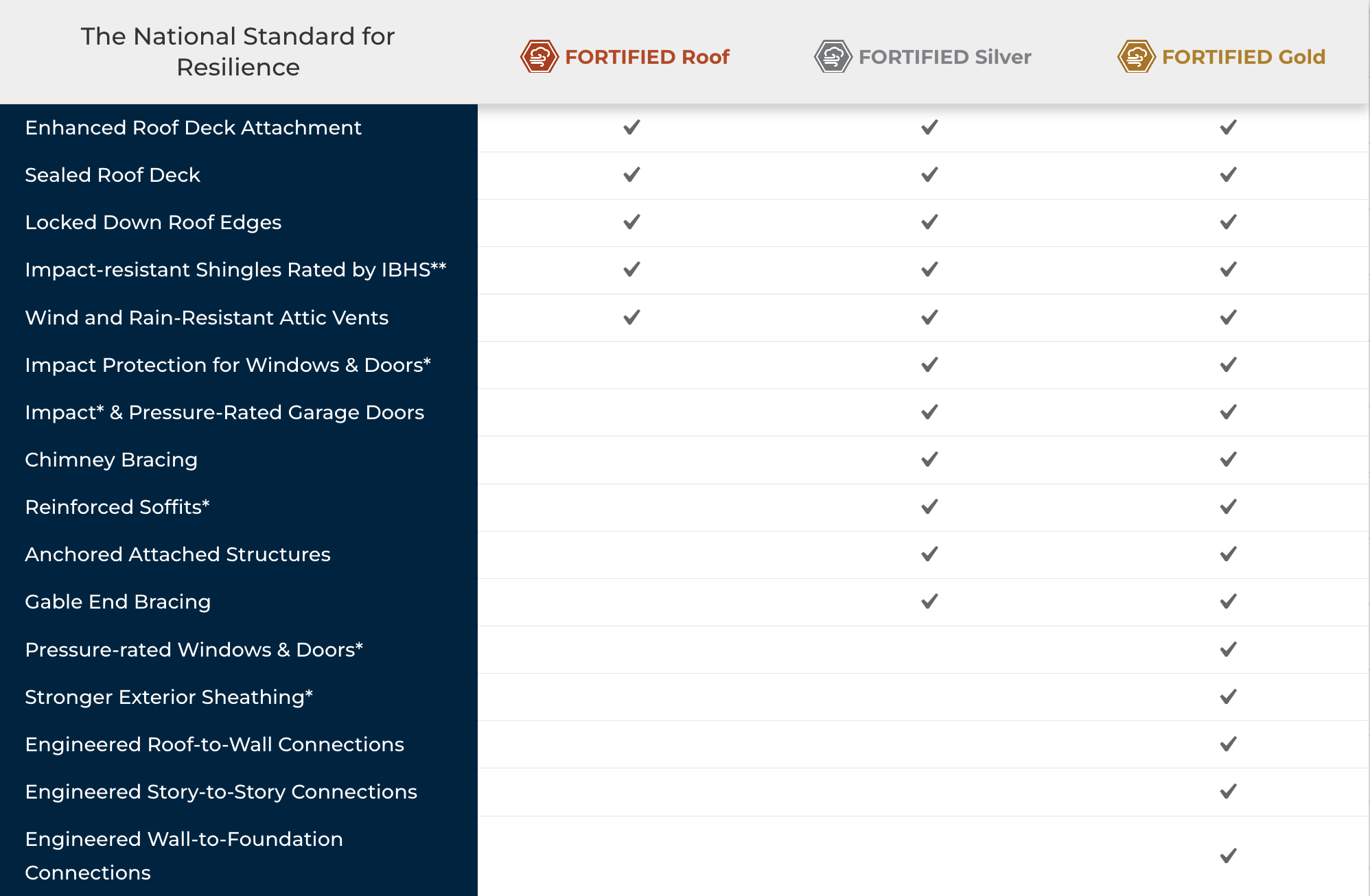
FORTIFIED Home standards, a voluntary beyond-code construction program from the Insurance Institute for Business & Home Safety (IBHS), offers three levels of fortifications that builders can adhere to.
Strengthen Your Roof (North Carolina) offers grants of up to $8,000 for eligible policyholders who install a FORTIFIED Roof through the North Carolina Insurance Underwriting Association (NCIUA).
Strengthen Minnesota Homes provides eligible homeowners with $10,000 for roof upgrades on insured homes.
Strengthen Kentucky Homes offers policy provisions for upgrading single-family dwellings to the FORTIFIED Home standard.
Federal Home Loan Bank of Dallas (FHLB) provides up to $15,000 to homeowners with low-to-moderate income to upgrade an existing roof, or up to $7,500 for new roof installation that levels up to FORTIFIED.
Improve the resilience of the building's exterior roof, wall construction, and coverings. The performance of these exterior components depends on using better materials and proper installation. For example, instead of using the more common, smooth nails, the FORTIFIED-required ring-shank nails can double the strength of a roof against the forces of high winds.
Reinforce and protect a structure’s openings (windows, doors, and garages). Not only are windows, doors, and garages expensive to replace, when they’re open, they can increase the pressure during a severe storm. For example, IBHS research found that shutting doors during severe weather can reduce pressure on a roof by 30%. Meanwhile, impact-resistant glass and glazing strengthens windows and doors to withstand severe storms.
Ensure that the structural integrity of a house during a high-wind event adequately transfers and distributes loads. The “load path connections” throughout a structure (e.g. how roof beams and walls connect, or how floors and walls connect) ensures a house can withstand high winds. Investing in proper construction, better materials, and reinforced connection points can reduce the damage of a severe storm.
Lever #3: Invest In New Innovations and Technologies
By far, the best way to reduce the costs of severe storms is to build and fortify structures to resilient standards. But in specific circumstances, new technologies and innovations can play a role in reducing costs.
Technology can reduce the damage to utility-scale solar projects. The majority of large, utility-scale solar projects use trackers, or systems that tilt the solar panels to follow the sun during the day. Increasingly, companies like Nextracker are producing hail mitigation products that connect to weather and use data to adjust panel angles ahead of hailstorms. Another company, ARRAY Technologies, has developed its SmarTrack technology that uses data to “stow” only the solar panel rows that are directly threatened by severe weather, allowing the rest to continue harnessing solar energy. HailDens360, developed by Kisters, is a high-resolution hailstorm forecast and sensing technology to minimize impacts to operations and assets.
Innovations can shield assets from hail. Companies like Hail No are manufacturing anti-hail nets to protect cars at dealerships and parking lots. Similar netting is used in agriculture to save crops from hail.
Conclusion
Severe storms are considered a secondary peril, a natural disaster type that is more frequent but generally less destructive. In spite of that classification, however, severe storms have become one of the most costly climate disasters in the U.S. There is no silver bullet to reduce their damage, but the private sector can play a major role in helping communities brace for the next storm.
Have thoughts to share on this piece, or want to add your voice to the conversation? Reach out!
Sign Up For The Epicenter
The Epicenter is a regular briefing that helps decision-makers understand the risks and impacts from climate hazards and discover practical, cost-effective resilience solutions.
Twenty-three billion-dollar weather and climate disasters struck the United States in 2025, revealing important takeaways for decision-makers in the real estate, public infrastructure, and insurance sectors.
Unexpected disasters are causing damage in unlikely places, forcing decision-makers in the public and private sectors to prepare for the most common disasters in their region as well as the rare, once-in-a-hundred-year ones. But strategies exist to help decision-makers prepare for the unexpected.
Across the U.S., the average annual total costs of earthquakes is $14.7 billion, with the average earthquake costing between $1.5 to $3 billion. Adopting the latest seismic resilience codes can make buildings more earthquake-resistant and financial instruments can help communities rebuild quickly.
There are no silver bullet solutions for the private sector to adopt to dramatically reduce the costs of winter storms. The biggest lever to bring costs down exists in modernizing and winterizing the grid—an endeavor that will require substantial technological, mechanical, and financial investments.