In this edition of The Weekly, we share a condensed version of a new article by Abby Ross, CEO of The Resiliency Company, on the four convictions underpinning the opportunities in the Adaptation Economy.
Four convictions drive an evolving investment thesis in the adaptation economy:
1) The adaptation economy is large and growing; 2) Resilience makes for more durable investments; 3) Investors see predictable growth and opportunity in the adaptation economy; 4) It’s still early and underserved.
RSG 3-D's non-combustible panel system offers a financially competitive alternative to conventional construction that delivers wildfire, earthquake, and hurricane resilience.
Four convictions drive an evolving investment thesis in the adaptation economy:
1) The adaptation economy is large and growing; 2) Resilience makes for more durable investments; 3) Investors see predictable growth and opportunity in the adaptation economy; 4) It’s still early and underserved.
By Abby Ross, Contributing Author for The Epicenter and CEO / Founder of The Resiliency Company
In 2011, Marc Andreessen of a16z wrote a famous blog post, Why Software Is Eating the World. For those in Silicon Valley working in software, it probably seemed like it was eating the world. And yet, after fifteen years when software became an ever larger part of our lives, it still only represents less than 5% of the U.S. GDP. Depending on how you define the boundaries, real estate and construction account for around 20% of the U.S. GDP.
In 2026, what’s really eating the world is how society adapts to climate instability. This is the adaptation economy, a segment of the larger economy that comprises disaster preparation, recovery, rebuilding, financing, insurance, and resilient adaptation. In the 1990s, the U.S. spent an average of $80 billion annually on the adaptation economy. Today, U.S. annual spending on the adaptation economy has reached almost $1 trillion.
Much of this growth is driven by the increasing frequency and severity of natural disasters. The climate continues to change.
The when and where of the next disaster are relatively unpredictable. But the pattern of bigger, more frequent, and more expensive disasters isn’t. It’s entirely predictable, and it’s creating a level of confidence amongst investors, operators, insurers, and financial institutions that there is a rare opportunity to boost our collective resilience at a population level and make money doing it.
The built environment needs to adapt: single-family homes, commercial real estate, public infrastructure. We cannot just rebuild to yesterday’s standards and yesterday’s conditions. It’s time to build for tomorrow’s reality.
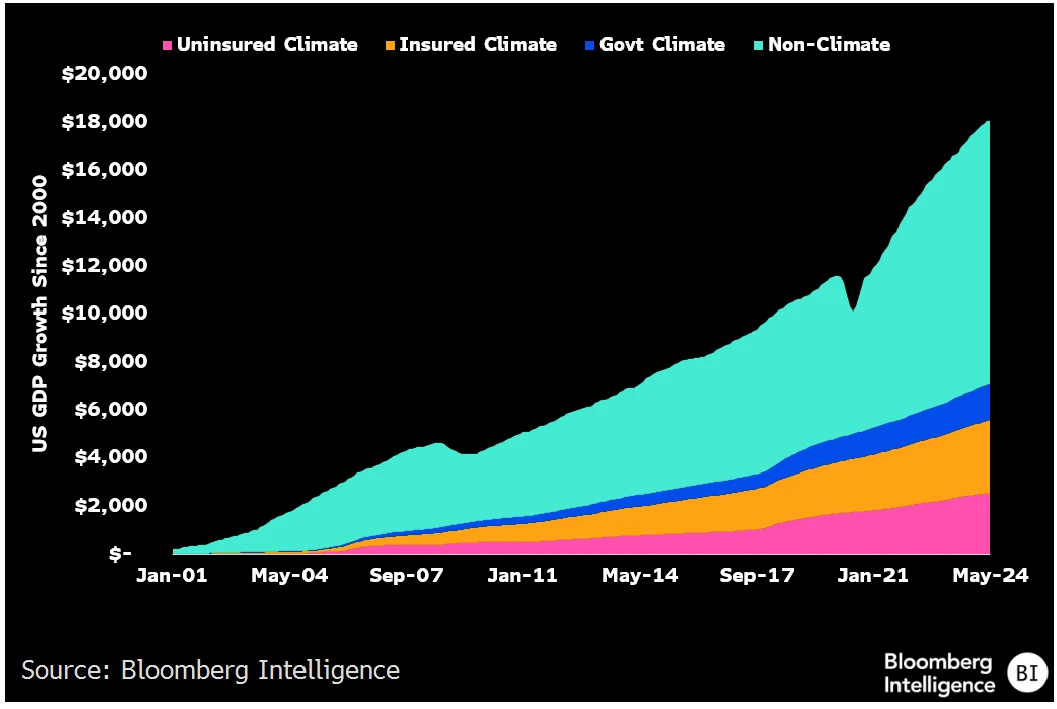
There are new investors and funds cropping up with an adaptation lens, from venture capital investors to private equity firms to public market investors. Bloomberg’s “Prepare and Repair Index,” a list of 100 public companies spanning waste haulers to engineering contractors to insurance companies, has outperformed the S&P 500 by 6.5% annually over the past decade. The graph below shows that U.S. spending on climate-related insurance premiums, infrastructure, and disaster recovery accounts for 40% of U.S. GDP growth since 2000, making climate one of the fastest-growing sectors of the economy.
In the last six months, I’ve had hundreds of private conversations with people operating and investing in the adaptation economy. Four common convictions keep coming up. In this article, I want to share these four convictions that form the emerging thesis for investing in the adaptation economy.
Conviction #1: Adaptation will touch everything
The adaptation economy is not as narrow a category as “climate mitigation.” Instead, it includes multiple sectors and industries—from manufacturing to real estate and financial services to supply chain management and logistics.
On the Climate Rising podcast, Jay Koh, the co-founder of the Lightsmith Group, a leading private equity firm focused on climate adaptation, described this as an unavoidable opportunity:
“Between now and 2030, a certain amount of climate impact is basically inevitable. It's baked into the atmosphere. And so the question is, what do we do about that and how do we prepare society for that? And then as investors, how do we think about what the opportunities to invest are created by that inevitable trend line?”
Chris Goolgasian, the Director of Climate Research and portfolio manager at the $1.2 trillion investment company Wellington Management, recently published an analysis citing research showing that by 2050, global spending on adaptation and resilience will exceed spending on climate mitigation by 6x ($38 trillion versus $6 trillion). Their analysis concluded that adaptation presents a “larger investment opportunity set” than climate mitigation, and one that is currently underfunded.
Conviction #2: Embracing adaptation leads to more durable investments
Investments with an adaptation/resilience lens will end up being better, more durable investments—particularly during times of unpredictability. From fortified roofs for single-family homes in Florida to fire mitigation services in California to large-scale water supply infrastructure in major cities across the country, the growth in frequency, size, and expense of climate disasters means the demand for these services is reaching a new normal.
For many investors, adaptation will become an investing lens—a way of looking at where and how to allocate capital. The analysis from Wellington Management points to this: There is a sizable investment opportunity in the “companies across a range of industries [that] are innovating on solutions that help the world build resilience to chronic and acute climate and extreme weather risks.”
Conviction #3: There is predictable growth and demand
The growth of the adaptation economy is based on the understanding that costly, frequent, severe disasters are now the new normal. Investors and entrepreneurs are using historical data from Climate Central’s database to forecast historical trends forward and allocate capital accordingly.
Koh described it like this on the Climate Rising podcast: “You know more about how climate change is going to unfold than you do about the path of inflation, interest rates, consumer behavior, artificial intelligence.”
But investors and entrepreneurs are not just looking at climate science or the frequency and costs of historical disasters; they’re also noticing observable shifts in public awareness. Governments of all levels, businesses of all sizes, and homeowners in nearly all zip codes are awakening to the need to design and build for today and tomorrow’s reality, not yesterday’s. As insurance premiums rise and damage increases, we’re witnessing a permanent, population-level shift in awareness of risk, vulnerability, and the need for resilience.
I’ve observed this public perception shift first-hand in California in the aftermath of the 2025 Los Angeles wildfires. Homeowners are seeking fire-resilient homes, builders are building fire-resilient communities, insurance companies are beginning to underwrite for fire-resilient construction, and regulators are recognizing that business-as-usual permitting needs to change.
Conviction #4: It’s still early and underserved
The adaptation economy is large and predictable, but it’s also a new category or lens for investors. Goolgasian at Wellington Management mentioned on the Climate Proof podcast that he’s noticed a shift in investor understanding. For a while, he said, he was educating investors on what an adaptation lens was. Now, sophisticated investors get it, and they’re sizing the market and identifying where to place capital.
Our partners at Adapt Unbound have begun tracking investors in the adaptation economy. So far, they have a database of 100+ investors active in the space across all asset classes. But the numbers are still small relative to the size of the opportunity, especially in early-stage equity investing.
According to Koh, “Over $95 billion has been raised for venture capital and private equity related to climate since 2021. Almost none of it is in this adaptation and climate resilience area. Less than 2% of 5% of climate-tracked investment capital on the planet is focused on adapting or building resiliency to climate change.”
This creates an asymmetrical opportunity for investors: a large, predictable market that’s underserved and under the radar. The reality is that investors are already making adaptation-related investments, whether they see it as part of the Adaptation Economy or not.
It’s time to build (with resilience)
In the middle of COVID, Marc Andreessen penned another post: It’s time to build. This post looked beyond software. He wrote,
“Our nation and our civilization were built on production, on building. Our forefathers and foremothers built roads and trains, farms and factories, then the computer, the microchip, the smartphone, and uncounted thousands of other things that we now take for granted, that are all around us, that define our lives and provide for our well-being. There is only one way to honor their legacy and to create the future we want for our own children and grandchildren, and that’s to build.”
It’s time to build in the adaptation economy. That trillion-dollar adaptation economy will create countless billion-dollar companies that are reconfiguring and rebuilding America’s physical and financial infrastructure (not to mention the thousands of sub-billion-dollar companies).
Direct Investing
For search funds looking to roll-up adaptation-oriented main-street businesses, or venture capitalists making the next investment in frontier technology, or public market investors allocating billions of dollars into public equities and debt markets, there’s alpha in the adaptation economy. For everyone else, there’s a more resilient future.
Adaptation as a Lens
Even if “adaptation” isn't a bullseye for your thesis, consider how understanding the realities of the adaptation economy can help portfolio companies. What does it mean for portfolio construction, your companies, and the market/customers they serve?
Go deeper
Ready to go deeper? Check out:
The list of 100+ adaptation investors (Adapt Unbound)
Climate adaptation may cost trillions. Is your portfolio ready? (Wellington Management)
In this edition of The Weekly, we share a condensed version of a new article by Abby Ross, CEO of The Resiliency Company, on the four convictions underpinning the opportunities in the Adaptation Economy.
RSG 3-D's non-combustible panel system offers a financially competitive alternative to conventional construction that delivers wildfire, earthquake, and hurricane resilience.
The Epicenter’s three-part home catalogs series from Alexis M. Pelosi and Robin Keegan describes how we arrived at the current moment and explores what it means for the future of housing after disasters and in communities facing disinvestment, outdated zoning, or housing supply constraints.
In an interview with The Epicenter, Joe Rozza of Ryan Companies explains what happens when a major storm hits mid-construction and why CRE leaders should give as much weight to their works in process as they do to projects on either end of the building spectrum.