RSG 3-D's non-combustible panel system offers a financially competitive alternative to conventional construction that delivers wildfire, earthquake, and hurricane resilience.
The federal government's retreat from climate adaptation has created a gap in data, funding, and coordination, but a new decentralized ecosystem of nonprofits, state governments, and coalitions is stepping up to fill the void and may prove more resilient to political disruption in the long run.
As federal disaster support shrinks, resilience districts offer local governments a promising new financing tool to fund climate adaptation on their own terms.
Insights & ideas on resilience straight to your inbox. Were you forwarded this email? → Subscribe here
Many year-end disaster reports—recaps and analyses of 2025’s biggest climate disasters—have been cropping up in recent weeks. And most of these reports cite the same source: Climate Central, which reports that 23 separate events in the U.S. in 2025 cost $115 billion in damages. The figures are worth digging into—but the bigger story is the fragile data infrastructure behind them, and why it matters for how risk is priced, capital is allocated, and resilience is planned.
The U.S.’s official billion-dollar weather and climate disasters database, maintained by NOAA since 1980, was discontinued in May 2025. For decades, this resource had been the gold standard for tracking catastrophic weather events—providing standardized, inflation-adjusted cost data that insurers, real estate developers, public agencies, and investors relied on for risk assessment and capital allocation. Its discontinuation could have created a critical blind spot, precisely when billion-dollar disasters are happening more frequently.
However, nonprofit research organization Climate Central moved quickly to keep the record from going dark. They hired Adam Smith, the senior scientist who had led NOAA's program for 15 years, to lead redevelopment. Smith brought methodology, data partnerships, and expertise, integrating data sources like insurance claims and crop damage assessments into a coherent framework. By October 2025, Climate Central had relaunched the database with data through June 2025; last week, they released their analysis of weather and climate disasters through the end of 2025.
This continuity will allow the data on climate disaster damages and costs to remain available and standardized for decision-makers across the resilience ecosystem, who need trustworthy, consistent data to plan effectively. But the billion-dollar database’s story could have ended differently, and it still might for other critical climate risk data resources.
The National Center for Atmospheric Research (NCAR), another pillar of climate and weather science, faces similar threats: the research center that helps forecast wildfire conditions and develops tornado warning systems has been targeted for "breaking up" by the Trump administration. If NCAR doesn’t experience the same soft landing that the billion-dollar disaster database has had, the effects could ripple into many industries—agriculture, insurance, utilities, logistics—that use their data for wind, weather, and disaster prediction.
Resilience is most visible in physical defenses and materials, but it relies on information infrastructure. When that information survives institutional upheaval, the whole ecosystem benefits from a credible foundation and a shared understanding of the climate risks that lie ahead.
Stay tuned for The Epicenter’s take on what leaders in public finance, real estate, the insurance sector, and beyond can learn from 2025’s billion-dollar climate disasters.
Their Homes Survived The L.A. Wildfires; A Year Later They Fear Living in Them | Insurance Journal | Many L.A. homeowners are still confronting lingering toxic contamination, as nonprofits like United Policyholders help fire survivors navigate insurance claims. Insurance Journal interviews residents facing health risks, mental stress, and years of rebuilding without clear support.
Climate Insurance Legal Action Surges as Property Damage Costs Rise | Financial Times | Lawsuits tied to climate-related losses are becoming a growing cost for both insurers and policyholders. As extreme weather damage intensifies, climate risk increasingly ends up in court—and litigation is becoming more “adversarial.”
Wildfire Smoke Is a National Crisis, and It’s Worse Than You Think | Grist | Once seen as a regional problem, wildfire smoke is affecting air quality across the U.S., with growing impacts on public health. Grist’s reporting explores how outdated planning can leave communities unprepared for prolonged exposure to smoke.
Shared Risk, Shared Resilience | SPUR | This in-depth, California-focused report argues that climate risk to infrastructure, from flooding to heat to seismic hazards, cannot be managed piecemeal. It calls for coordinated regional planning, shared financing, and governance reforms to build resilience at a larger scale.
Read more about resilient public infrastructure and government solutions on The Epicenter here.
Real Estate & Construction
Even Without Hurricanes, U.S. Disaster Costs Surpassed $100B Last Year | The New York Times | Twenty-one different thunderstorms caused at least $1 billion worth of damage in 2025, with intensifying weather and population sprawl putting more people and property at risk every year.
Why Construction Standards Must Catch Up to a Changing Climate | Environmental Protection | As heat, flooding, and extreme weather become more intense, existing building standards are falling short. Environmental writer Jane Marsh argues that codes and safety regulations must evolve faster to protect workers, occupants, and long-term investments.
Read more about resilient real estate on The Epicenter here.
Private Investment
Adapt or Absorb the Hit: What U.S. CEOs Said About Climate Risk in Q4 | Climate Proof | Earnings calls show a growing divide between companies investing in climate adaptation and those treating extreme weather as a one-off cost. The analysis digs into how corporate leaders are pricing climate risk into strategy, operations, and long-term planning.
How Cities Are Turning Environmental Disclosure Into Action | Smart Cities World | Companies, cities, states, and regions are disclosing environmental information, including climate risk, through the environmental disclosure platform CDP, which just released its environmental transparency “A List.” This emissions and risk data can then guide investment, infrastructure upgrades, and resilience strategies.
Active Construction Sites Are Climate Risk Blind Spots: Lessons from Hurricane Ian | The Epicenter Editors | In an interview with The Epicenter, Joe Rozza of Ryan Companies explains what happens when a major storm hits mid-construction and why CRE leaders should give as much weight to their works in process as they do to projects on either end of the building spectrum.
Winter Storms: The Cost Drivers and Associated Opportunities for Investors | The Epicenter Editors | There are no silver bullet solutions for the private sector to adopt to dramatically reduce the costs of winter storms. The biggest lever to bring costs down exists in modernizing and winterizing the grid—an endeavor that will require substantial technological, mechanical, and financial investments.
Investing to Minimize Flooding and Protect Critical Water Resources | Erin Delawalla | Historically, strong federal environmental regulations drove government action to manage water resources—that’s changing as more communities experience flooding and see the benefits of nature-based solutions to mitigate those impacts.
The Statistic of the Week
10 days
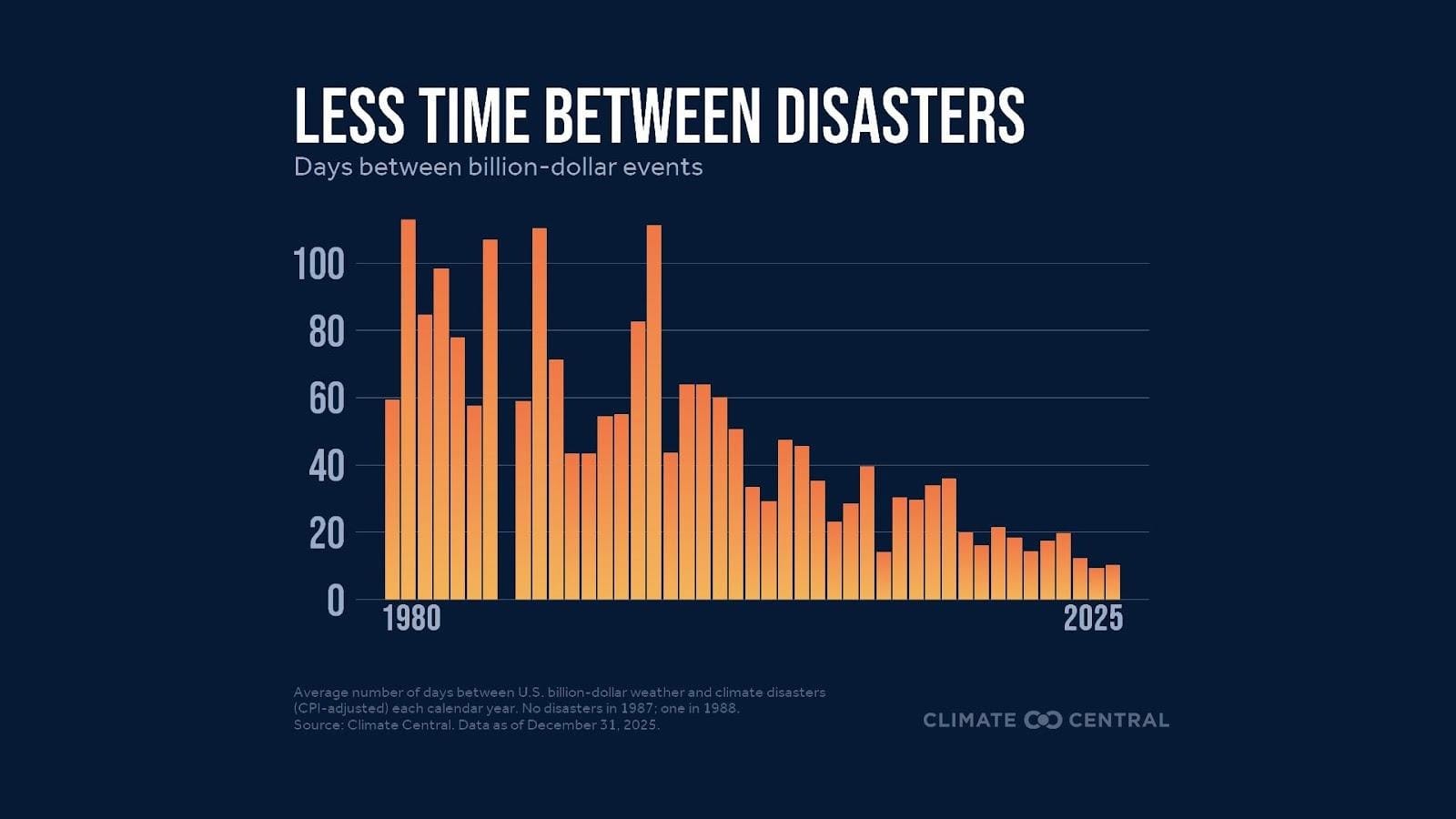
On average, the U.S. had just 10 days between billion-dollar disasters in 2025, compared to over 80 days in the 1980s.
Have thoughts to share or want to add your voice to the conversation? Reach out!
The Epicenter helps decision makers understand climate risks and discover viable resilience solutions. The Epicenter is an affiliated publication of The Resiliency Company, a 501(c)3 nonprofit dedicated to inspiring and empowering humanity to adapt to the accelerating challenges of the next 100+ years.
The lack of standard home rebuilding playbooks, combined with the uneven delivery of federal disaster recovery funding, has led to fragmented rebuilding efforts over the past few decades. However, disaster recovery has evolved to more systematic approaches using pre-approved home plan catalogs.
Twenty-three billion-dollar disasters, $115 billion in damage, and not one hurricane: 2025 was a masterclass in how climate risk in the U.S. has changed.
Twenty-three billion-dollar weather and climate disasters struck the United States in 2025, revealing important takeaways for decision-makers in the real estate, public infrastructure, and insurance sectors.
Nine months after the Eaton and Palisades fires, the Department of Angels released a large, community-level survey in October offering a detailed look at how homeowners perceive their recovery experience.