

The Weekly: Hurricane Isaias Is a Test of the Gulf Coast’s Bet on Hardened Homes
Florida and Alabama have spent hundreds of millions fortifying homes. Isaias is the first mainland hurricane to test that resilience since 2024.
Florida and Alabama have spent hundreds of millions fortifying homes. Isaias is the first mainland hurricane to test that resilience since 2024.

Resilience benefits are often spread so widely that no single payer sees the payoff. New models and policies are starting to close that gap.
Two years ago, sessions on resilience were hard to find at Climate Week NYC. This year, they were everywhere.
How public, private, and philanthropic leaders can scale the next chapter of climate resilience. A national call to action prepared for Chicago Climate Week and Aspen Ideas: Climate.

By Matt Posner and Xavier de Souza Briggs
This week, leaders from across the nation will come together in Chicago for a week of dialogue and solution-building around America’s climate challenges. In sessions at Aspen Ideas: Climate, the adjacent Resilient America Summit (focused on fiscal risk and public finance), and in other venues, there’s much to talk about, including a reset that cannot come too soon.
Communities throughout the U.S. are entering a new era of climate adaptation. For decades, attaining greater resilience from extreme weather or related shocks was treated primarily as an environmental objective or an emergency management responsibility. Major investments typically were made after disasters occurred, and were funded through hard-to-use federal recovery grants, insurance payouts, or state and local “rainy day” funds. What’s more, those investments did not consistently focus on reducing risk by rebuilding to a better standard. The urge to simply restore what existed before, as economically as possible, is strong.
That model is increasingly untenable—both economically and fiscally unsustainable. It’s also short-sighted because weather-related losses continue to rise. Property insurance is becoming more expensive and less available in many parts of the country, threatening to create what former Fed Chair Jerome Powell, in testimony before Congress early last year, warned would be growing “mortgage deserts”—where homebuying would be out of reach to most people. Likewise, investors, lenders, utilities, healthcare systems, employers, and real estate developers are paying more attention to the economic consequences of physical risk—as a core balance sheet issue, not just a matter of environmentally friendly “sustainability” practice. The combination of growing climate-related losses, private insurer withdrawal, and federal cutbacks means that state and local governments bear an increasing share of the fiscal risks tied to extreme weather, as Pew Research recently detailed. At the same time, states and localities are being asked to invest more in other needs, such as housing supply and affordability, modernizing infrastructure, and making up for dramatic reductions in federal funding for critical services such as healthcare.
These trends and competing pressures create both a challenge and an opportunity.
The challenge is that governments cannot rely solely on taxpayer funding, especially grant-centered strategies fueled by taxes, to significantly reduce future risk. Bond debt, lending for homes and commercial real estate, and insurance innovation matter more than ever.
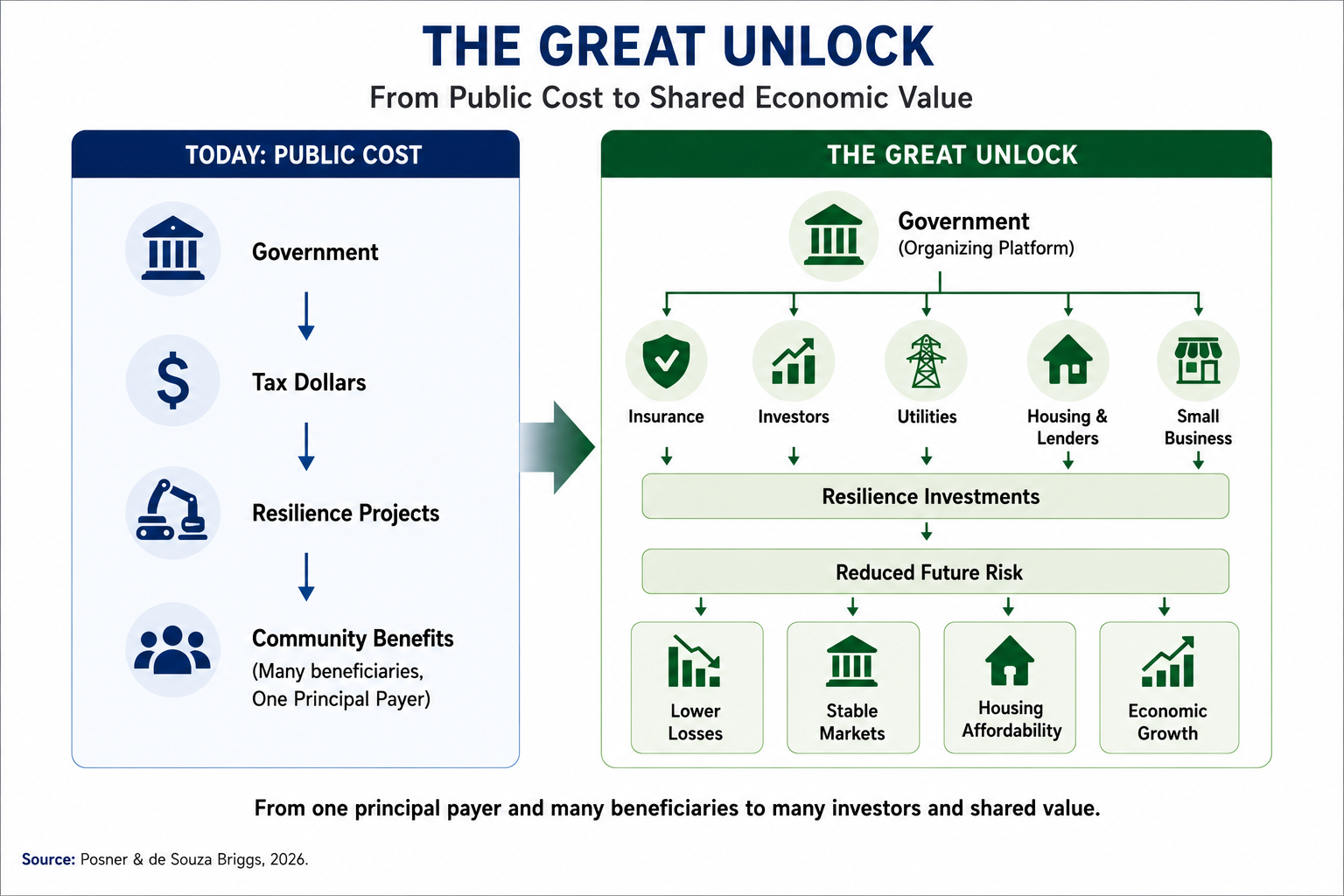
The opportunity lies in the fact that resilience investments create value for many players in the economy, not only for government. This is “the Great Unlock”: When that value can be measured and demonstrated, major new sources of capital—from mortgages and home equity loans to infrastructure bonds and insurance savings—become available to help finance resilience.
The traditional resilience funding model assumed, at least implicitly, that government would fund or finance most physical protection. Two reasons explain why. First, many of the benefits—to utilities and public services, for example—were hard to measure and assign to private parties, such as individual homeowners or enterprises. Second, private property insurers and reinsurers, operating under their traditional business models, were not motivated to directly incentivize risk reduction.
The emerging model recognizes that resilience creates measurable value for risk reduction across multiple sectors and stakeholders in the economy, from the scale of one household to the scale of an entire community.
For example, stronger homes reduce insurance claims and may make losses more predictable as well—a key to effective modeling and fair pricing. More physically resilient housing also supports mortgage markets and more stable property values. Better infrastructure improves the reliability and affordability of water and power services. Health systems experience fewer operational disruptions during extreme events, not to mention fewer high-cost and stressful emergency room visits in times of crisis. In direct and indirect ways, lower disaster losses also protect state and local balance sheets and the tax base.
But the case for the Great Unlock, as a simple way of expressing the emerging model, hinges on a crucial investment fact as well: These benefits accrue across institutions that collectively invest trillions of dollars in communities, much of that in the built environment. And state by state, we are beginning to document and understand how to shift that investing toward resilience as a norm, not an exception, let alone an unaffordable luxury.
From innovative and proven homeowner resilience incentive programs in Alabama, North Carolina, and other southeastern states—where FORTIFIED Roofs represent a major, insurer-recognized success story—to institutional innovations for community-wide risk reduction in California, Illinois, Massachusetts, Rhode Island, and other parts of the country, leaders are highlighting the financial case, mobilizing and aligning interests, and using a mix of rules and public/private incentives to drive change. We explained several of these success stories and highlighted their lessons in research published by The Brookings Institution last fall.
Newer initiatives, such as The Resilient Delta Fund in Los Angeles, are bringing philanthropic institutions, building industry companies, and public sector partners together around home lending for resilient rebuilding after the 2025 wildfires—a crucial step to make communities more resilient in California, Colorado, and other fire-prone states.
The first step of the Great Unlock is turning relatively passive beneficiaries into active resilience partners who bring resources that change the game. A growing body of results shows how: The transition begins with the public sector serving as an organizing platform to align multiple actors around a shared objective.
State and local governments occupy a unique position in this transition. In terms of functions and authority, they govern land use, oversee building standards, finance most new infrastructure, regulate insurance markets, operate residual “public option” insurance plans, support housing affordability, spur economic development and economic resilience, and manage long-term public assets, such as transportation systems, water and wastewater infrastructure, schools, and other critical infrastructure that underpin community resilience. As previewed above, in terms of exposure, they also carry significant financial risk because climate hazards affect public buildings, infrastructure, budget reserve (“rainy day”) funds, and property and sales tax bases.
Because governments sit at the center of these systems, they are uniquely positioned to create the conditions under which resilience becomes investable. But often, we have found, business and civic partners, including philanthropy, help determine whether—and how effectively—that potential gets realized.
Across the country, states are beginning to demonstrate robust and scalable approaches. Some, such as insurer-recognized FORTIFIED homes, begin at the household level, as The Resiliency Company will document in a forthcoming set of case studies produced in collaboration with Duke University’s Nicholas Institute for Energy, Environment, and Sustainability. The mechanisms for scaling these approaches include direct public appropriations that incentivize hazard mitigation (analogous to rebates and other consumer incentives to promote energy efficiency in homes), insurance-sector funding mechanisms that recycle industry revenues into risk-reducing investments, tax incentives for stronger housing construction, capital market innovations that connect catastrophe bonds with mitigation-driven savings, and blended capital structures that seek to repay investments through documented reductions in future insurance losses.
Individually, these models are financing innovations. Collectively, they represent the early architecture of a broader adaptation economy, as Resiliency Company CEO Abby Ross has defined it.
The Great Unlock depends upon governments creating the conditions that allow other actors to participate in the underappreciated, undermeasured financial and economic value of resilience:
Each sector has different motivations, but each benefits when communities become more resilient. And that will happen at scale only if we understand and leverage the Great Unlock.
The next generation of resilience will not be built through public sector grants alone or, on the market side, from payouts by property insurers. Insurers, though long central to how the nation manages risk and finances the built environment, are struggling to adapt their business models to new climate realities. There are anxious and frustrated consumers on one side and growing losses on the other.
Scaling deep and durable resilience and making it the new default will require governments that understand their exposure, quantify future losses, and integrate resilience into financial decision-making (as California Forward proposes in Paying for Preparedness, a detailed fiscal case for enhancing state investment in climate resilience). It will require private sector partners that recognize the economic value created by reduced risk. It will require philanthropic innovators willing to support market development alongside direct community investment and a traditional focus on building the nonprofit sector.
The Great Unlock is ultimately about aligning these actors around a shared objective: When resilience is treated as a valuable financial asset, not a luxury or simply a public expense, new forms of investment become possible. The examples now emerging in more and more states demonstrate that this transition has already begun. The challenge now is to accelerate it and make it standard practice nationwide.
Matt Posner leads the Public Finance Practice and Resilient America initiative for The Resiliency Company, a 501(c)3 nonprofit.
Xavier de Souza Briggs is a senior fellow at The Brookings Institution, a policy think tank, and executive in residence at the School of Government and Policy at Johns Hopkins University.
Have thoughts to share on this piece, or want to add your voice to the conversation? Reply here.

Florida and Alabama have spent hundreds of millions fortifying homes. Isaias is the first mainland hurricane to test that resilience since 2024.

Resilience benefits are often spread so widely that no single payer sees the payoff. New models and policies are starting to close that gap.

Two years ago, sessions on resilience were hard to find at Climate Week NYC. This year, they were everywhere.

Municipal markets overlook the cost of aging infrastructure. New tools can help cities size their reserve funds against their actual exposure.