

The Weekly: El Niño Is a Stress Test for America’s Infrastructure. It Can Show Us Where to Invest Next.
There is a 75% chance that El Niño strength will exceed every event on record since 1950.
There is a 75% chance that El Niño strength will exceed every event on record since 1950.

To address the housing crisis in the U.S., we need a three-part strategy for centering resilience.
If we don’t build it right and build it to last, new housing supply won’t solve today’s housing crisis.
There is a 75% chance that El Niño strength will exceed every event on record since 1950.

Predictions about El Niño have been hard to miss in the headlines. NOAA's Climate Prediction Center puts the odds above 90% that this winter’s event will become “very strong,” and the odds at 75% that its strength between October and December will exceed every event on record since 1950.
El Niño is a natural phenomenon in which above-average sea surface temperatures in the central and eastern tropical Pacific Ocean disrupt normal weather patterns. It arrives every two to seven years. A "very strong" version is rarer, reaching that threshold only three times since 1950. Each El Niño’s impact is hard to predict, but a “very strong” El Niño will produce greater variations and instability throughout the U.S. It could have the following regional impacts:
As this year’s El Niño ramps up, California is buckling down for severe storms and coastal flooding; the state just declared a state of emergency in anticipation of El Niño’s arrival. As Mark Merrifield of the Scripps Institution of Oceanography put it in a recent Guardian article: A strong El Niño “gives us a bit of a stress test of what the state [of California] is likely to experience with future climate change.”
A stress test can be valuable. El Niño will hit each region differently, but expose similar underlying challenges: Much of the infrastructure needed to manage climate risk is easier to fund after a disaster than before one.
That makes the months ahead useful for two kinds of preparation: preventative maintenance to reduce the effects of this year’s El Niño, and infrastructure modernization to plan for the next time a strong El Niño comes around.
With only a few months before El Niño storms hit, large-scale infrastructure updates to improve stormwater capacity and management aren’t possible. But there’s plenty of preventative maintenance that can be done in the short term.
In California, that work is already underway. Los Angeles County crews are clearing sediment and boulders from debris basins—work that restores flood-storage capacity lost to years of sediment accumulation. They’re paying close attention to the Palisades and Eaton burn scars, where U.S. Geological Survey modeling found a 60% to 80% chance of intense-storm debris flows, a type of landslide that can occur after fires have burned through the vegetation that held soil in place. San Diego plans to clear 20 miles of storm channels and is raising public awareness about flood insurance.
This kind of work doesn't require a new bond measure, a multiyear design process, or a new piece of infrastructure. But maintenance shouldn't be where the preparation ends. If this winter reveals places where stormwater systems are undersized, or flood defenses are already operating close to their limits, those failures can become a to-do list for future infrastructure improvement projects and repairs.
As ocean temperatures warm, stronger El Niños may become more likely. Research on the eastern Pacific's faster warming suggests extreme El Niño events that arrived once every 20 years last century could now arrive nearly twice as often.
If infrastructure appears vulnerable as this El Niño looms, it’s a good reason to examine exactly where the cracks are. San Diego, for example, says it has $3.3 billion of stormwater improvements to make, with four dams still needing safety repairs. Those projects can’t be completed in time for this winter, but the approaching storms can make their importance more tangible for policymakers.
Meanwhile, California is capturing more stormwater and storing it for dry periods. In a Politico article, Karla Nemeth, former director of the California Department of Water Resources, describes El Niño as a test of the state's ability to capture water. “I think we are as ready as we can be, but [there's] more work to be done to get that water saved for a drought.”
For local officials, the most valuable preparation for this El Niño season may be financial as well as physical: knowing what a range of storm scenarios would cost and how much their city or state budget can absorb. The RiskReserves Tool, developed by the Government Finance Officers Association and The Resiliency Company, provides that view, enabling local officials to make the case for investments in resilience before the next storm hits.
Request a demo here.

Read more about resilient public infrastructure and government solutions on The Epicenter here.
Read more about resilient real estate on The Epicenter here.
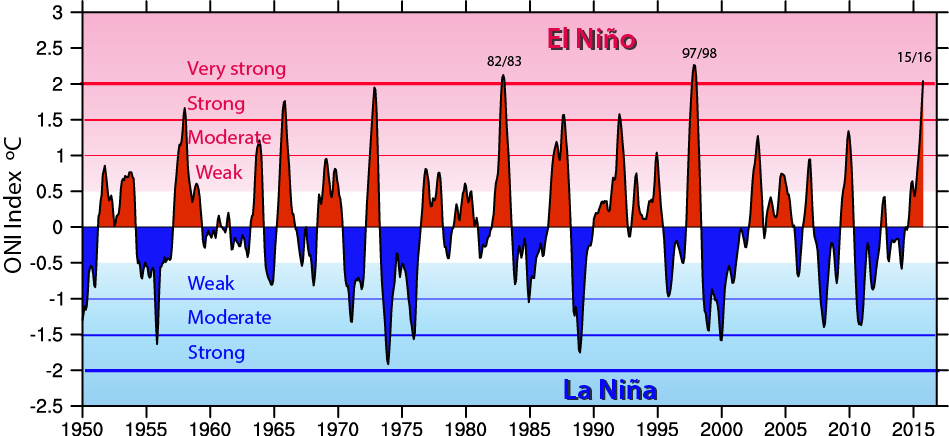
There have been three “very strong” El Niño weather patterns since 1950. This year’s will be the fourth.
Source: NCAR
Have thoughts to share or want to add your voice to the conversation? Reach out!
The Epicenter helps decision-makers understand climate risks and discover viable resilience solutions. The Epicenter is an affiliated publication of The Resiliency Company, a 501(c)3 nonprofit dedicated to inspiring and empowering humanity to adapt to the accelerating challenges of the next 100+ years.

For most of the country, in most years, the post-disaster window is not the second-best time to invest in resilience. It is the only time anyone does.

Three lessons from the Rebuilding with Resilience Summit

Wildfire season is changing how utilities fortify against wildfires

Corpus Christi's bond downgrades reveal a governance problem, not just a risk problem