
The Weekly: Alabama Used Five Financing Levers to Scale Resilient Building Standards Across the State
Alabama’s approach to scaling the FORTIFIED standard has become a blueprint nationwide.
Alabama’s approach to scaling the FORTIFIED standard has become a blueprint nationwide.

Alabama used five financing levers to get insurers and homeowners to pay for FORTIFIED roofs.
Florida and Alabama have spent hundreds of millions fortifying homes. Isaias is the first mainland hurricane to test that resilience since 2024.
Alabama used five financing levers to get insurers and homeowners to pay for FORTIFIED roofs.

When Hurricane Sally hit Alabama’s Gulf Coast in 2020, homes with FORTIFIED roofs filed 55% to 74% fewer insurance claims than conventional homes. That result traces back to decisions the state started making 15 years earlier.
In 2004 and 2005, Alabama endured two brutal hurricane seasons. Hurricane Ivan caused an estimated $14 billion in damages. A year later, Hurricane Katrina made landfall in Louisiana and Mississippi but still pushed storm surges of 10 to 15 feet into Alabama’s Mobile County.
According to the Alabama Department of Insurance, the back-to-back storms threatened the viability of the state’s insurance market. To stabilize the market and protect communities, state leaders realized they needed to make resilient construction the norm statewide.
Today, more than 53,000 Alabama homes have been built or re-roofed to FORTIFIED, a construction standard developed by the Insurance Institute for Business & Home Safety (IBHS).
A new case study from Duke’s Nicholas Institute for Energy, Environment & Sustainability and The Resiliency Company examines how Alabama has layered five financing and policy levers around the FORTIFIED standard, creating a model that can scale to other states.
“Alabama demonstrates that resilience financing does not always require creating an entirely new financial instrument,” the case study authors said. “Sometimes the most effective innovation is aligning existing market incentives.”
Here’s what The Resiliency Company and The Nicholas Institute found about Alabama’s system, and how other states are applying the state’s blueprint.
IBHS, a nonprofit research organization funded by the insurance industry, developed FORTIFIED as a voluntary construction and re-roofing standard to strengthen buildings against severe weather. In the mid-2000s, Hurricanes Ivan and Katrina helped spur its adoption along the Gulf Coast. In 2010, IBHS released its FORTIFIED Home–Hurricane program, which provides guidance on retrofitting existing homes to resist high winds and wind-driven rain.
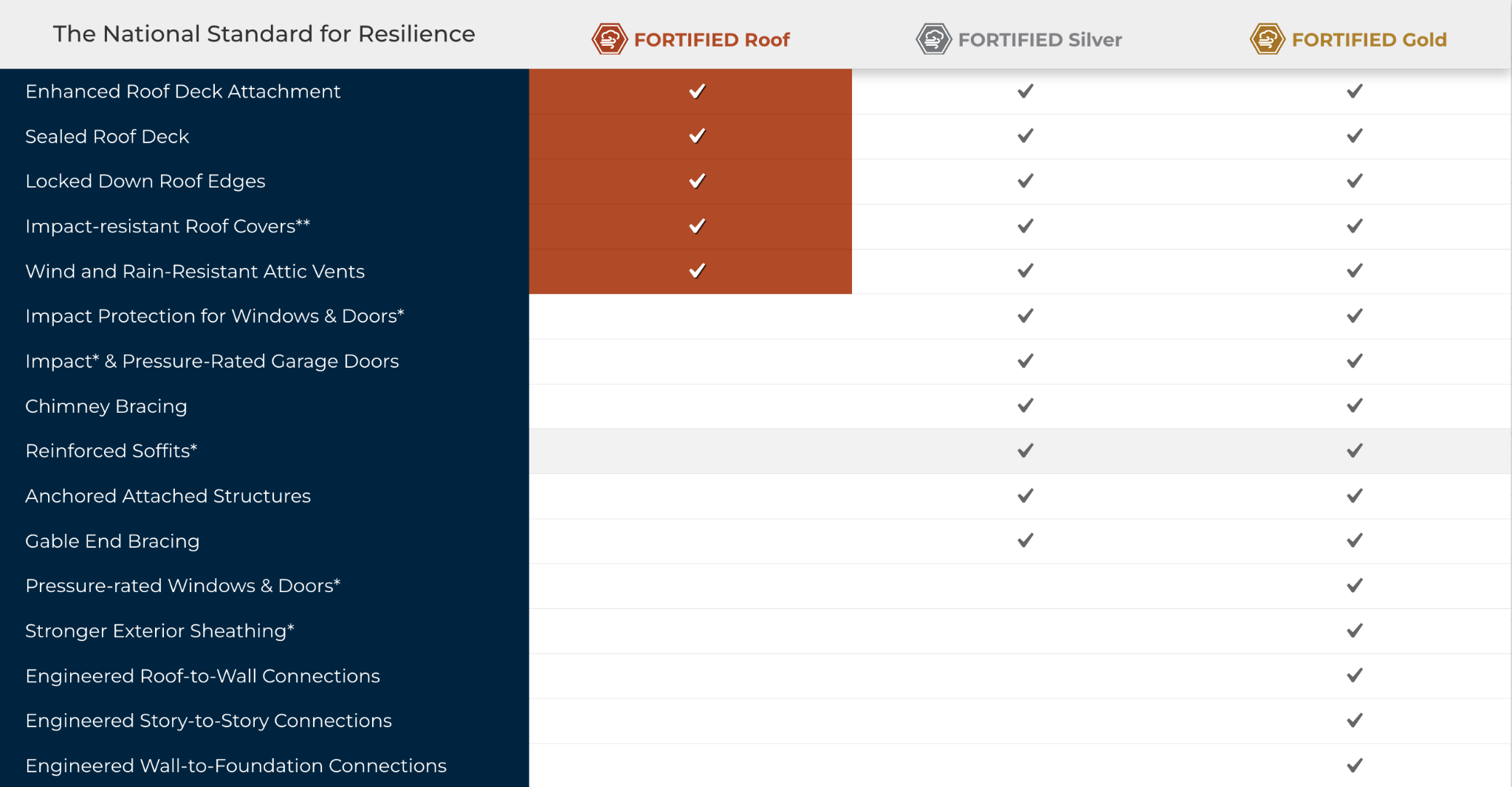
The designation addresses a home’s roof system as a whole: It sets requirements for the roof covering itself and how the roof deck attaches to the framing, how the deck is sealed as a secondary water barrier, and how roof edges prevent wind from ripping it away. Two higher tiers, Silver and Gold, extend the standard to other parts of the building, like windows, chimneys, and walls.
To achieve certification, an evaluator documents the construction work, and IBHS reviews the submission before offering a designation. The paper trail provides insurers, lenders, and state programs a verified standard they can reliably price and fund.
After Hurricane Ivan in 2004, the nonprofit Smart Home America brought FORTIFIED to the attention of state and community leaders. Then it worked with local governments to adopt a Coastal Construction Code Supplement that brought construction standards closer to FORTIFIED. Jurisdictions in Alabama’s two coastal counties, Baldwin and Mobile, started adopting the supplement in 2012, and Alabama’s Department of Insurance reported that more than 70% of jurisdictions in those two counties have since added FORTIFIED recommendations.
When Hurricane Sally made landfall on the Alabama coast in September 2020, many of the homes in its path were FORTIFIED. A study by the Alabama Department of Insurance and the University of Alabama’s Center for Risk and Insurance Research compared those homes with conventionally built ones. FORTIFIED Roof construction reduced how often homeowners filed a claim (claim frequency) by 55% to 74%. It also reduced how large those claims were (claim severity) by 14% to 40%. For insurers, loss ratios fell by 51% to 72%. The loss ratio is the share of premiums an insurer pays out in claims.
Many homeowners also come out ahead when they sell. Research in the Southern Economic Journal found FORTIFIED-designated homes sell for roughly 7% more than comparable non-designated homes.
Researchers could measure how FORTIFIED roofs performed in Hurricane Sally because, by 2020, Alabama had fortified enough coastal homes to compare against conventional construction. To reach that scale, Alabama combined five financing and policy mechanisms that enabled homeowners to adopt the FORTIFIED standard. According to the case study, together they represent “a self-reinforcing model in which every participant benefits from lower risk.”
The financing and policy levers were added over roughly 15 years. Each lever applies to a different moment in the lifecycle of a roof: Grants cover the upfront cost, discounts reward finished work, the Stronger Roof Endorsement kicks in during the replacement process after a claim, and two tax tools support households that can pay for roof upgrades on their own.
For state and municipal leaders, policymakers, and insurance regulators seeking to learn from and replicate Alabama’s success elsewhere, the five financing levers represent a blueprint.
Here’s how each lever works:
Strengthen Alabama Homes (SAH) is the state’s grant program for FORTIFIED roof upgrades, administered by the Alabama Department of Insurance. Starting in 2016 in Mobile and Baldwin counties, SAH began offering grants of up to $7,500. Now, grants run up to $10,000 per home, with no income threshold. The grants are funded by insurance department regulatory and licensing fees, plus authorized transfers from the Insurance Department Fund. The program requires IBHS-certified evaluators, approved contractors, and certification before payment. Since 2016, SAH has awarded roughly $86 million to retrofit about 8,700 homes, contributing to more than 53,000 FORTIFIED designations statewide.
The program also solves a coordination problem: Insurers sign annual policies with homeowners, so they aren’t incentivized to finance retrofits for any individual home. If a homeowner switches carriers a year after they upgrade, their original insurer would have paid for the retrofit without benefiting from future savings from lower claims. A state-administered grant helps create a market-wide incentive for risk reduction without relying on insurers to finance retrofits directly.
Because SAH pays only for work done by IBHS-certified evaluators and approved contractors, it also builds a workforce of evaluators, contractors, and roofers experienced in building to the standard. “This market-making function may be one of the program’s most important contributions,” wrote the case study’s authors.
In 2009, Alabama created the first mandatory insurance discounts for FORTIFIED construction in Mobile and Baldwin counties. In 2015, the Alabama Legislature passed SB 254, creating required, statewide FORTIFIED insurance discounts. Now, discounts are commonly 15% to 35% depending on the FORTIFIED tier. The state sets the benchmark, which makes discounts consistent across carriers and easier for homeowners to understand. By lowering premiums after the work is done, the discount creates “a clear financial incentive for homeowners to pursue resilient construction,” according to the case study. Any homeowner with a verified designation qualifies, with no income or geographic restrictions.
In 2019, Alabama passed HB 283, which required insurers to offer a FORTIFIED roof endorsement. Normally, when a storm destroys a roof, an insurance policy pays to replace it with a roof that meets the local building code. The Stronger Roof Endorsement is an optional add-on that costs the homeowner slightly more in premium. It covers the extra cost of rebuilding to the FORTIFIED standard. Insurers must offer this optional endorsement on new policies for non-FORTIFIED homes, and at the first renewal of existing ones. The endorsement takes advantage of the post-disaster window when a storm has destroyed a roof and a homeowner must replace it. By incentivizing homeowners to invest in a more resilient replacement through standard insurance claims processes, the Stronger Roof Endorsement offers a mechanism other states can adopt.
Alabama provides a state income tax deduction for homeowners who self-finance retrofits, including to the FORTIFIED standard. The deduction allows households that pay for hurricane and wind-resilience upgrades themselves to deduct 50% of retrofit costs, up to $3,000 per property. The deduction “[reduces] the effective cost of resilience investment,” according to the case study, and works best for households with enough disposable income to pay upfront and enough tax liability to benefit. The current policy refines 2011’s SB 395, which created a retrofit tax deduction for hurricane and wind-resilience upgrades, without mentioning FORTIFIED standards.
Since 2012, Alabama has allowed homeowners to open catastrophe savings accounts: dedicated savings accounts, labeled as such at the bank, where they can set money aside for storm-related costs. Contributions can be deducted from state income taxes, and the account’s interest is exempt from state tax, too. The accounts were originally meant to cover uninsured windstorm costs, chiefly insurance deductibles, making them a disaster-recovery tool. Recent legislative changes expanded eligible uses to include premiums for the Stronger Roof Endorsement and other resilience-related costs, so homeowners can now use the tax-exempt money to protect a home before a storm hits. The Nicholas Institute-Resiliency Company case study frames this as a shift from a disaster-recovery tool to “a pre-disaster resilience financing tool” that “aligns financial preparedness with physical risk reduction.”
In May 2026, IBHS announced that FORTIFIED passed 100,000 designations across 34 states, with more than 20,000 issued in 2025. Several states have borrowed Alabama’s levers or developed their own. Smart Home America, which helped design SAH, has helped push the model to states like Louisiana and Oklahoma. The Resiliency Company and Nicholas Institute’s broader report on how states are financing property-level resilience (of which Alabama is one case study) highlights success stories in other states:
Hurricane Isaias, the first hurricane to reach the Gulf Coast this year, was the latest test of Alabama’s roofs. The storm made landfall near Destin, Florida, as a Category 2 storm on October 9, with Alabama’s Gulf Coast also in its path. As of mid-October, Moody’s risk management services division estimated that insured losses from Hurricane Isaias to range between $2.5-$4.5 billion.
Over the coming months, loss data from FORTIFIED and conventional roofs along the coast will show how the Alabama model held up against Isaias.
One early signal points in its favor. According to real estate data and analytics company Cotality, properties built to resilient building standards, like FORTIFIED properties, had “much lower loss severity” than conventional construction.
If the claims data confirms that pattern, legislators and insurance regulators in other states will have another data point to show that Alabama’s model is working.
Have thoughts to share on this piece, or want to add your voice to the conversation? Reach out!

Alabama’s approach to scaling the FORTIFIED standard has become a blueprint nationwide.

Florida and Alabama have spent hundreds of millions fortifying homes. Isaias is the first mainland hurricane to test that resilience since 2024.

Two years ago, sessions on resilience were hard to find at Climate Week NYC. This year, they were everywhere.

Municipal markets overlook the cost of aging infrastructure. New tools can help cities size their reserve funds against their actual exposure.