A new set of case studies and a policy brief lay out how states are financing property-level resilience improvements that reduce disaster losses, improve housing affordability, and stabilize stressed insurance markets.
The Weekly: The Tools to Finance Resilience Already Exist. To Unlock Scale, We Need Coordination.
We need to move beyond asking simply, How do we fund this project? and start asking, What financial risk does this community face, what outcomes could change that trajectory, and how should we invest accordingly?
Insights & ideas on resilience straight to your inbox. Were you forwarded this email? → Subscribe here
- Feature: Three takeaways from the first Resilient America Summit. - From the archive: New Jersey's stormwater utilities are a funding source for flood infrastructure. - In the news: Who bears rising commercial property insurance costs?
Opportunities & Resources
Express Your Interest: The 2026 Rebuilding with Resilience Summit in Los Angeles on August 18th
The Resiliency Company, in partnership with the Department of Angels, is convening builders, community leaders, advocates, local governments, financing partners, insurers, and resilience practitioners for a day focused on one question: How does rebuilding with resilience become the norm?
Space is limited. Readers of The Epicenter can get 10% off the ticket price with the code EPICENTER. Click here to express your interest in attending on August 18th.
Get Early Access to Our Report: How States Are Financing Property-Level Resilience
States across the country are developing innovative approaches to finance property-level resilience investments that reduce future losses from natural hazards.
The Resiliency Company has teamed up with The Nicholas Institute to produce a report on lessons from six states that have scaled IBHS FORTIFIED roof adoption. The report includes lessons for policymakers, philanthropy, insurers, and investors seeking to scale resilient housing.
The Verdict From The Resilient America Summit: Financing Resilience Is A Coordination Problem.
By Matt Posner, the Public Finance lead for The Resiliency Company.
On July 23 in Chicago, The Resiliency Company brought together nearly 100 leaders from state and local government, public finance, insurance, philanthropy, infrastructure, investment, and the broader resilience ecosystem to explore a fundamental question at the Resilient America Summit: What will it take to move resilience from a recognized need to something communities can actually finance and deliver at scale?
Resilient America is a new initiative of The Resiliency Company, and the inaugural Summit surfaced a consistent set of themes about where the resilience field needs to go next.
As the organizer of the Summit and the head of the Public Finance practice for The Resiliency Company, here are three that stood out:
1. Resilience has to become part of how governments make financial decisions.
Physical risk ultimately becomes fiscal risk—through damaged infrastructure, disrupted revenues, higher operating costs, insurance pressures, and repeated recovery spending. Yet these risks are still too often treated as resilience issues rather than financial ones.
A major theme of the Summit was the need to move resilience out of a silo and into the financial systems governments already use to manage risk and allocate capital. The Resiliency Company and the Government Finance Officers Association (GFOA) have been developing a RiskReserve Tool (RRT) that uses Monte Carlo simulation to translate a range of future risks, including natural hazards, into potential financial losses and then tests those losses against a government’s reserves.
At the Summit, Shayne Kavanagh of the GFOA and I demonstrated how the RRT applies evidence-based risk modeling to help local governments determine how to appropriately capitalize reserve funds based on their actual financial exposure. (Want to know more about the RiskReserve Tool? Reach out to schedule a demo.)
The emerging resilience financing model, what Xavier De Souza Briggs and I define in a recent Epicenter article as “The Great Unlock,” requires coordination, scale, and nonprofit and public delivery models.
3. Resilience is a team sport—but the government is at the center.
No single institution can solve community risk alone. The Resilient America Summit's core diagnosis was that resilience is a coordination problem, not a cost-benefit problem. No single actor has authority to move the whole system, but state and local governments are uniquely positioned to convene that ecosystem because they own assets, set policy, allocate capital, and ultimately bear many of the consequences when risks materialize.
Where we go from here
One of the clearest takeaways from the Summit was that resilience needs both a common financial starting point and a team around the table.
We need to move beyond asking simply, How do we fund this project? and start asking, What financial risk does this community face, what outcomes could change that trajectory, and how should we invest accordingly?
The RiskReserve Tool (RRT) provides a starting point: a common dataset that translates a community’s risks into potential liabilities through the lens of the government budget.
Then comes the work of bringing governments together with public finance, philanthropy, nonprofits, insurers, investors, and practitioners in a trusted setting to work through their specific challenges and identify solutions.
That is the model we want to proliferate through Resilient America. Join the Resilient America network to stay involved as we bring this approach to more communities.
This is an excerpt from an article on Matt’s takeaways from the first Resilient America Summit. Read the full article here.
The Great Unlock | Matt Posner and Xavier de Souza Briggs | How public, private, and philanthropic leaders can scale the next chapter of climate resilience. A national call to action prepared for Chicago Climate Week and Aspen Ideas: Climate.
Wildfires: Opportunities For the Private Sector | The Epicenter | Part II of our Wildfires Briefing explores four categories of opportunity for the private sector: 1) Implementing modern building materials and codes; 2) Technologies for better fire management; 3) New insurance models; and 4) Private financing for forest management.
The U.S. Is Now At Its Worst Level of Wildfire Preparedness. What Does That Mean? | TIME | Federal wildfire officials have raised the nation's preparedness level to “level 5,” signaling that firefighting resources are stretched thin as peak fire season intensifies. The designation means that aircraft, crews, and equipment may not be available for every new blaze.
Integrating Technology Into Cities for Sustainable Urban Development | World Governments Summit | A report from the World Governments Summit and Deloitte argues that urban resilience will increasingly depend on how well cities integrate technologies like AI, digital twins, IoT, and predictive analytics into infrastructure and governance.
Rising Seas Magnify the Dangers of Coastal Georgia’s Industrial Past | Grist | Rising seas and stronger storms are creating contamination risks at Georgia's legacy industrial sites, where flooding could spread pollution from aging Superfund locations into surrounding communities. A new Superfund research center will study how increased storms and flooding could breach containment measures.
Read more about resilient public infrastructure on The Epicenter here.
Housing
IBHS Rounds Out Wildfire Prepared Program With Neighborhood and Multifamily Standards | Insurance Institute for Business & Home Safety | IBHS has expanded its Wildfire Prepared program beyond single-family homes, introducing standards for neighborhoods and multifamily properties. The changes reflect a growing recognition that wildfire resilience is shaped as much by community-wide mitigation as individual property upgrades.
Why El Niño’s Promise of Quieter Hurricane Season May Not Be Good News for Insurers | Insurance Journal | Even in quieter hurricane years, soaring property values and continued growth in high-risk coastal areas mean a single landfall can trigger record-breaking losses, prompting insurers to focus less on storm counts and more on the value and location of exposed real estate.
Who Bears Rising Commercial Property Insurance Costs? | Brookings Institution | Commercial property insurance premiums for multifamily buildings have more than doubled as a share of rental income between 2019 and 2024. While landlords initially passed some of those costs on through higher rents, that ability has largely disappeared as insurance shocks become larger. The study suggests that these rising costs are accelerating consolidation, as larger real estate firms are better positioned to manage growing risk.
Read more about resilient housing on The Epicenter here.
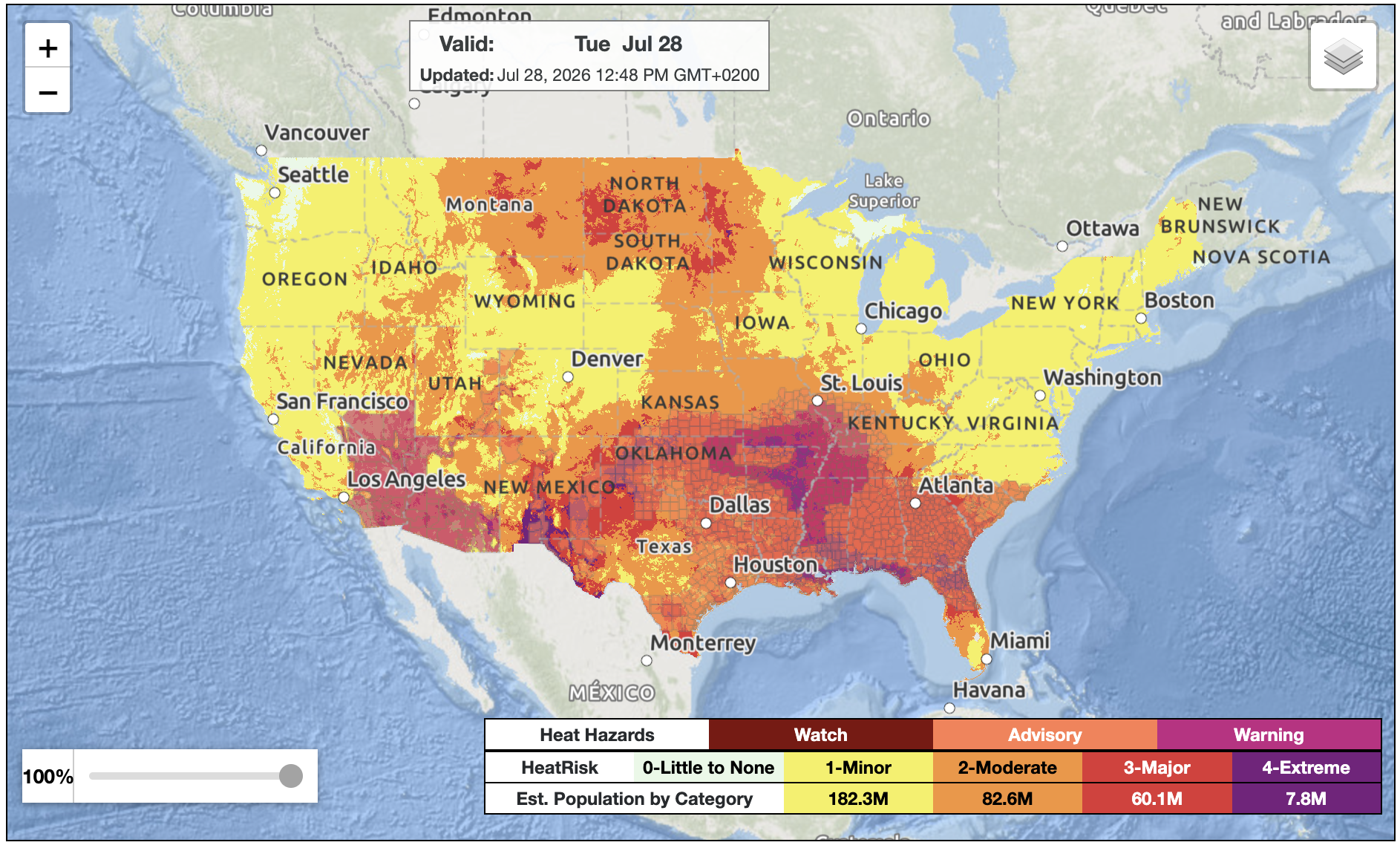
The Chart of the Week
This week, much of the U.S. has been under a major or extreme heat advisory. Over 134 million people were under a heat warning or advisory on Monday—that’s about a third of all Americans.
Have thoughts to share on this piece, or want to add your voice to the conversation? Reply here.
The Epicenter helps decision makers understand climate risks and discover viable resilience solutions. The Epicenter is an affiliated publication of The Resiliency Company, a 501(c)3 nonprofit dedicated to inspiring and empowering humanity to adapt to the accelerating challenges of the next 100+ years.
A new set of case studies and a policy brief lay out how states are financing property-level resilience improvements that reduce disaster losses, improve housing affordability, and stabilize stressed insurance markets.
Los Angeles isn't short on ideas or expertise. But, like many communities rebuilding after a disaster, it lacks the connections, systems, and capacity to bring them together at scale.