The Weekly: New York City’s Blueprint for Flood Resilience
Last week, New York City experienced another round of flash flooding thanks to a violent downpour, highlighting a thorny question: When do you harden infrastructure against stormwater, and when do you work with it?
Insights & ideas on resilience straight to your inbox. Were you forwarded this email? → Subscribe here
Last week, just after the thirteenth anniversary of Hurricane Sandy, New York City experienced another round of flash flooding thanks to a violent downpour. The record-breaking rain came down at about 6 inches per hour, highlighting a thorny question: When do you harden infrastructure against stormwater, and when do you work with it? According to a New York Times analysis, nearly 30% of the city’s land mass could face significant flooding by 2080.
In its current iteration, the city's stormwater system is meant to accommodate 1.75 inches of rain per hour; according to the Times, storms have exceeded that rate in three out of the past five years.
"So much of our infrastructure was built for a world and a climate that doesn't exist anymore," says Daniel Zarrilli, who served as the city's first Chief Resilience Officer from 2016 to 2018. After Sandy's devastating 14-foot storm surge, Zarrilli helped create a $20 billion adaptation program that drew money from federal disaster recovery grants, state programs, municipal budgets, and utility investments. This "sources and uses" capital stack, as Zarrilli’s team put it, aligned multiple funding streams toward reinforcing critical hospital, subway, and utility infrastructure across the city.
Fortification is half the solution; the other half requires working with water rather than trying to wall it out. Speaking to the Times, landscape ecologist Eric Sanderson explained that in New York, the areas currently facing the highest risk of flooding overlap almost exactly with the city's historical wetlands.
Manhattan's contemporary flood maps are essentially X-rays of a buried ecological landscape, with the springs, streams, and wetlands that once absorbed rainfall now plugged and sealed under pavement.
The pattern repeats across American cities with startling consistency. Houston's catastrophic flooding follows the contours of an ancient river network and filled-in prairie wetlands. Chicago’s basements and sewers overflow in the footprint of a drained swamp. San Francisco's Mission Bay—once a tidal marsh—floods during heavy rains.
Reconnecting with lost waterways is becoming a key part of New York's resilience arsenal. The city's new plan for the flood-prone Jewel Streets neighborhood unearths portions of Spring Creek, giving floodwater a place to go as it heads toward Jamaica Bay. Staten Island's successful Bluebelt Program, funded partially by a Hurricane Sandy recovery grant, has built and preserved natural drainage corridors.
The city's dual approach—hardening critical assets and restoring ecological systems—offers a blueprint for cities nationwide. But “there's a lot that hasn't been done yet, that needs to be done, to protect people and upgrade infrastructure and coastal protections,” Zarrilli says.
It’s a puzzle for newly elected New York Mayor Zohran Mamdani to consider as he inherits a city designed for a milder century. Mamdani’s campaign has been relatively quiet on flood protection, although his proposal to turn 50 public schools into year-round resilience hubs—shelters during heat waves and flooding—suggests he knows that storms are coming. With some 80,000 homes projected to flood over the next 15 years, the city will have to move fast.
Read our full interview with Daniel Zarrilli here.
They Survived the Hurricane. Their Insurance Company Didn’t. | Grist | The story of a Louisiana family left waiting years for their claim to be paid reveals the fragility of the state's property insurance market, which buckled under the financial strain of Hurricane Ida. Over a dozen local insurers have since failed or fled, leaving the state's last-resort safety net overwhelmed and deep in debt.
Don’t Look Now, But Citizens Is No Longer the Largest Property Insurer in Florida | Insurance Journal | Following recent legislative reforms, Florida's state-backed insurer of last resort, Citizens Property Insurance Corp., has reduced its policy count, a sign that private carriers are returning to the market. This marks a critical step toward stability, but the underlying question of long-term climate risk exposure remains for the state to answer.
Neighborhood Data Project Probes Environmental Challenges | GovTech | The Baltimore-Social Environmental Collaborative is deploying monitoring sensors in historically disinvested neighborhoods to collect hyper-local data on flooding and heat, empowering communities to advocate for policy changes despite a major federal funding cut.
FEMA Delays $11B in Reimbursements as States Brace for Tighter Disaster Budgets | Smart Cities Dive | Due to a projected shortfall in its Disaster Relief Fund, FEMA has delayed $11 billion in reimbursements, creating financial uncertainty and straining local governments’ ability to fund crucial disaster response and resilience work.
Read more about resilient public infrastructure and government solutions on The Epicenter here.
Real Estate & Construction
Economic Development in Its Place | Brookings Institute | With federal cuts, tech disruption, and an affordability crunch reshaping real estate markets, Brookings calls for a reset in how communities plan and invest. This report outlines a four-pillar framework for smarter land use, linking development goals, investment choices, and equity to help cities grow sustainably.
Taking Stock in Altadena Nine Months After the Devastating LA Fires | Inside Climate News | Nine months since the January wildfires torched homes in Altadena, California, residents are trying to piece their lives back together. In this article, one homeowner describes their experience with community solidarity, insurance gaps, and rebuilding to fire resistant standards.
Read more about resilient real estate on The Epicenter here.
Private Investment
The Business of Grid Resilience | Climate Proof | In Climate Proof’s podcast, the CEO of Rhizome, which offers climate threat modeling and analysis for utilities, discusses the growing focus on grid resilience as “one of the hottest niches in adaptation tech.”
SenseNet Secures $14M to Scale Ultra-Early Wildfire Detection Tech | HPCwire | SenseNet has announced $14 million in funding to expand U.S. installations of their wildfire-detecting technology, which already covers 130 million acres globally. Their system combines gas sensors, cameras, and satellite and weather feeds, designed to identify wildfires early and stop them as soon as possible.
Read more about private investment on The Epicenter here.
From Recovery to Resilience: NYC's Innovative Response to Hurricane Sandy | The Epicenter Editors | The Epicenter editors recently interviewed Daniel Zarrilli, former Chief Resilience Officer for New York City and current Chief Climate & Sustainability Officer at Columbia University, about his work during the post-Hurricane Sandy recovery effort.
Severe Storms: Opportunities to Reduce the Costs | The Epicenter Editors | In just a few hours, a severe storm can cause billions worth of damage. Three levers offer opportunities to enhance resilience and reduce the costs of severe storms: 1) Invest in more resilient roofing; 2) Adopt more resilient construction practices; 3) Invest in new innovations and technologies.
Five Pillars of Climate-Adaptive Insurance | The Epicenter Editors | An adaptation-minded property insurance system means safer, healthier, more resilient communities and economies that can both prepare for and recover from climate disasters in an affordable, sustainable, equitable way.
The Statistic of the Week
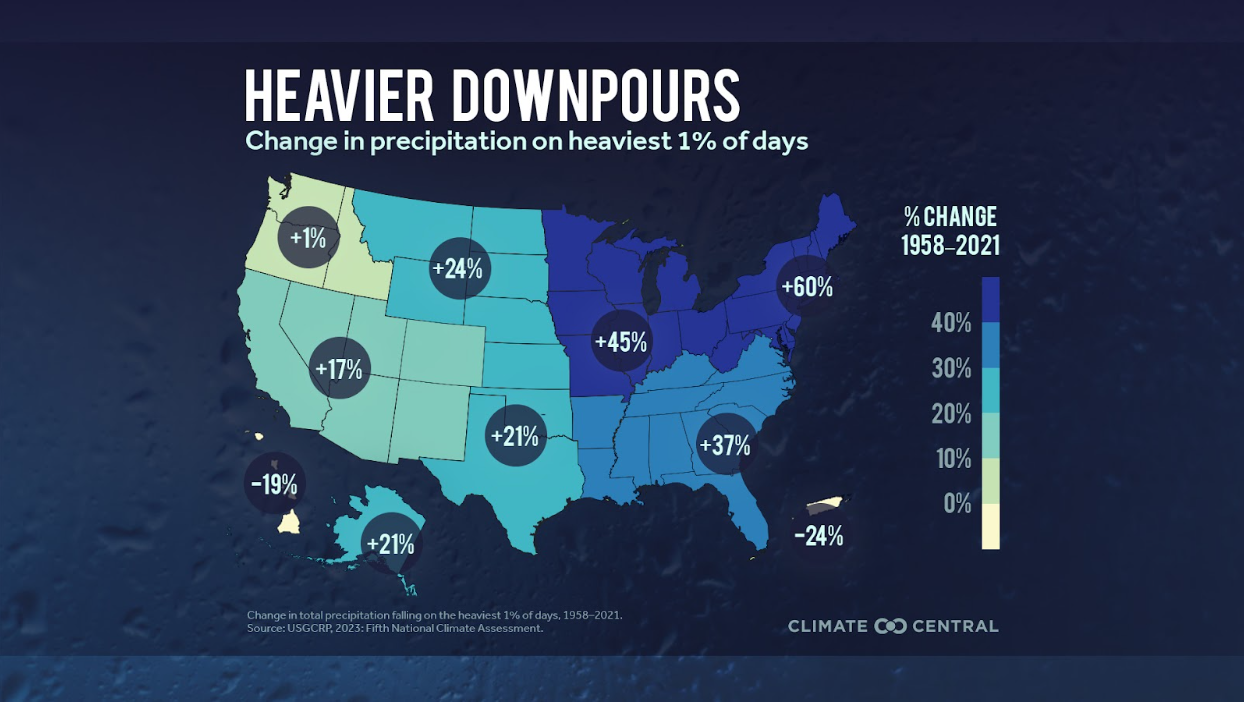
60% more rainfall
There has been 60% more rainfall during the heaviest rain events in the Northeast since 1958.
Have thoughts to share or want to add your voice to the conversation? Reach out!
The Epicenter helps decision makers understand climate risks and discover viable resilience solutions. The Epicenter is an affiliated publication of The Resiliency Company, a 501(c)3 nonprofit dedicated to inspiring and empowering humanity to adapt to the accelerating challenges of the next 100+ years.