
Two Years After Prop 4, California’s Climate Bond Is Moving From Budget to Projects
California has set aside most of its $10 billion climate bond, but little has reached projects. New rules aim to change that.
California has set aside most of its $10 billion climate bond, but little has reached projects. New rules aim to change that.

Proposition 137 sends about $83 million a year to forest health, fuels reduction, and watershed work, starting in mid-2027.
The analytics have never been better. Opening access could unlock much more investment in resilience.

California has set aside most of its $10 billion climate bond, but little has reached projects. New rules aim to change that.

On November 5, 2024, California voters passed Proposition 4, authorizing a $10 billion climate bond program to fund wildfire prevention, flood protection, coastal restoration, and other projects that help the state prepare for climate change. It’s the largest climate and natural resources bond passed by any U.S. state.
The state is now working to accelerate the transfer of spending authorized by Prop 4 to on-the-ground projects.
About $6.2 billion has been appropriated, but only a “relatively small amount” has reached projects so far, according to the Legislative Analyst’s Office (LAO). The state has responded by easing rulemaking requirements, letting departments pool funds, and making it easier to move spending authority between agencies. Here’s how the money moves, where it stands, and what other states are trying.
Prop 4 lets California pay for major climate projects now and spread the cost over decades. It authorizes up to $10 billion in general obligation bonds. These are repaid from the state’s general tax revenue rather than from project income. California will repay the borrowed money, plus interest, over roughly 40 years, using taxpayer money. The four stages are:
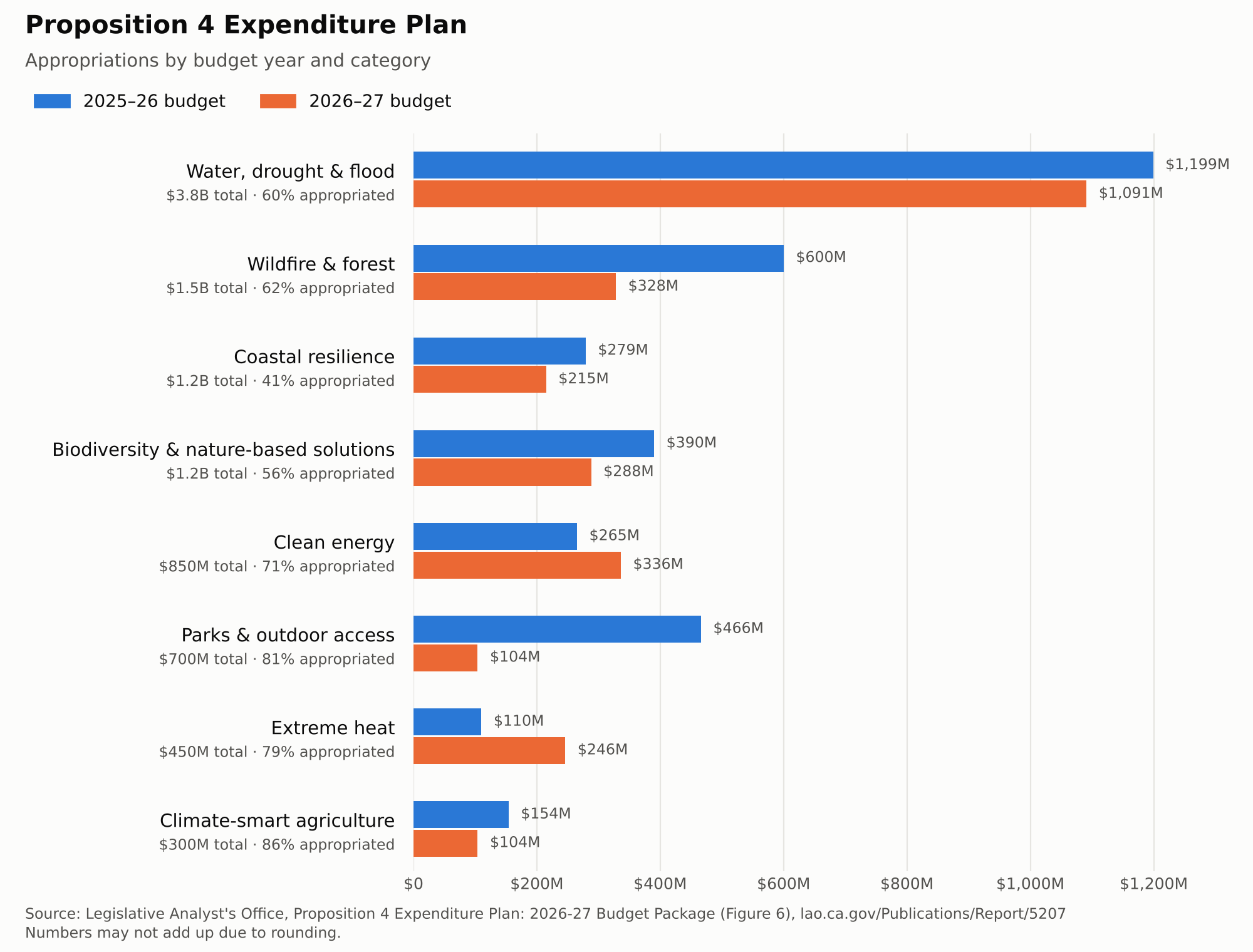
Appropriated money gives agencies permission to spend, but this doesn’t mean the money has been deployed. The 2025–26 budget appropriated about $3.5 billion, and the 2026–27 budget added $2.71 billion. That leaves roughly $3.7 billion unallocated after bond administration costs.
Progress varies across Prop 4’s eight funding categories. Climate-smart agriculture leads, with just over 86% of its funding appropriated, followed by parks and outdoor access at 81%. Coastal resilience trails at 41%.
Wildfire programs are among the first to see Prop 4 money. Since November 2025, the Coastal Conservancy and Sierra Nevada Conservancy have awarded roughly $14.7 million to 15 wildfire resilience projects. In May 2026, CAL FIRE launched a $30 million Regional Wildfire and Landscape Resilience Grant Program.
Departments are building programs from scratch, and rulemaking requirements have slowed them down. In its February review, LAO found departments were still establishing the grant programs needed to distribute the money. Many were going through emergency rulemaking procedures for the first time. These allow state agencies to quickly adopt the regulations needed to kickstart new programs, but require officials to master implementation requirements and other rules. Earlier natural resources bonds had exempted their programs from those requirements.
The State Coastal Conservancy is one example where the administrative process has caused issues. LAO cited “unanticipated delays in the emergency rulemaking process and staffing capacity constraints” at the agency. Those delays may help explain why coastal resilience lags other categories.
A new law lets Prop 4 programs skip a lengthy regulatory step. AB 35, signed in July, exempts Prop 4-funded programs from adopting regulations under the Administrative Procedure Act when setting grant guidelines and selection criteria. The Administrative Procedure Act is the state’s formal process for writing agency rules. Under AB 35, departments instead submit proposed guidelines to the California Natural Resources Agency. CalMatters reports the change could save climate projects 12 to 18 months.
Departments can also now pool money and share spending authority. LAO’s October update notes new statutory language that:
Some funds are going straight to local projects chosen by legislators. CalMatters identified around $250 million in Prop 4 “earmarks” in one 2025–26 budget bill. Most fund local needs such as fire stations and parks. However, these earmarks also shrink the pool for competitive grants, which favor projects with the greatest ecological benefits. The Wildlife Conservation Board, for example, normally awards Prop 4 habitat grants competitively. But roughly a quarter of the $339 million the Legislature gave it in 2025–26 must go to projects named by lawmakers.
At the local level, bond money is seen as necessary, but not enough on its own. A spokesperson for the City of San Diego told The Epicenter: “While Prop 4 can be instrumental in helping to move some infrastructure and restoration projects forward, the need to fund ongoing monitoring and maintenance of those restoration projects remains and is critical to project success.”
Bonds help California work around a volatile budget. The state relies heavily on personal income taxes paid by high earners, whose incomes can swing with the stock market. Bonds let the state raise money upfront for long-lived projects and repay it slowly.
Revolving loan funds are one alternative. These funds lend money to communities, then use repayments to finance new loans. They tend to work best for projects that generate revenue, such as stormwater or wastewater upgrades backed by utility fees.
Local governments are using general obligation bonds with a narrower scope. This year, voters in St. Petersburg, Florida, approved up to $600 million in bonds for flood protection and water and wastewater improvements. The city estimates the bonds will cost property owners about $96 a year for every $100,000 of taxable property value. The bonds will let the city finish a $2.7 billion resilience program in 19 years instead of the 24 originally projected.
Every financing model faces a version of the same challenge: getting from an authorized pot of money to a built project. As Prop 4 enters its third year, California will continue to offer lessons on building the administrative and program capacity to distribute billions of dollars.
For more on where Prop 4 money is going, check out the California Natural Resources Agency's Climate Bond Accountability site. The site shows which programs are funded, how dollars are being spent, and details about individual projects. You can also search funding pots and grant opportunities, or browse the full list of Prop 4 projects.
Have thoughts to share on this piece, or want to add your voice to the conversation? Reach out!

Proposition 137 sends about $83 million a year to forest health, fuels reduction, and watershed work, starting in mid-2027.

The analytics have never been better. Opening access could unlock much more investment in resilience.

Kansas City’s levees finished on schedule, years ahead of the original estimate.

In Altadena, a new approach is helping to shrink the ‘resilience delta’ between standard and more resilient building codes.