

The ‘Resilience Shopping List’ Making Home Wildfire Upgrades Affordable
In Altadena, a new approach is helping to shrink the ‘resilience delta’ between standard and more resilient building codes.
In Altadena, a new approach is helping to shrink the ‘resilience delta’ between standard and more resilient building codes.

From a $600 million storm-resilience bond in St. Petersburg to drainage renewals in coastal Louisiana, Tuesday’s election results show strong local support for well-defined adaptation investments.
Data from the wettest summer in five years reveals three opportunities to invest in resilience.
In Altadena, a new approach is helping to shrink the ‘resilience delta’ between standard and more resilient building codes.

On Pine Street in Altadena, California, volunteers from San Gabriel Valley Habitat for Humanity—clad in white hard hats—fitted the walls for a new home in place, stud by stud. Soon after, they installed a roof cap of galvanized steel, alongside dual-paned tempered glass, fiber cement siding, and other innovative materials designed to harden the property against a future wildfire.
Together, these upgrades brought the new home beyond the local building code and up to the Wildfire Prepared Home Enhanced standard set by the Insurance Institute for Business & Home Safety (IBHS). The result: a much more resilient home for not much more money. Once donated materials were included, the extra cost came to just 3-5% of the build.
The home on Pine Street is one of more than 30 that San Gabriel Valley Habitat for Humanity (SGV Habitat) is rebuilding in Altadena after the 2025 Eaton Fire. To price the upgrades, the nonprofit, together with The Resiliency Company, built a “resilience shopping list” of two dozen components that improve a structure’s ability to withstand wildfires.
After a disaster, a flurry of standard protocols, overseen by a familiar set of institutions, kicks into gear to support recovery: federal aid, state programs, nonprofits, insurance payouts. While essential, these processes are focused on rebuilding what was lost, rather than building something new—and more resilient. In many places, the norm has always been to rebuild to code.
Given how destructive wildfires have become—and the evidence that they are only likely to get worse—rebuilding to code is often not enough to protect a home from embers and flames. From 2010 to 2020, wildfires destroyed more than three times as many homes and other structures in the western United States as in the prior ten years, according to a 2023 study by researchers at the University of Montana and the University of Colorado. And recent research suggests that without adaptive action, the number of properties lost to wildfires could triple nationwide by 2060.
Yet only 21% of the country’s jurisdictions have adopted resilient building codes, covering just 38% of the U.S. population. This despite evidence that such codes are effective at reducing losses. Florida’s statewide wind code, enacted after Hurricane Andrew in 1992, has cut windstorm losses by 72% since 2002. Data from Alabama’s FORTIFIED program, a grant program that helps homeowners upgrade to storm-resilient roofs, offers another example. After Hurricane Sally made landfall in 2020, homes with FORTIFIED roofs outperformed those that didn’t: 73% fewer claims, 15% lower claim amounts, and 72% lower total losses.
However, communities don’t have to wait for new codes to be enforced. They can rebuild to more resilient standards voluntarily—and reap the rewards.
In Los Angeles, homeowners rebuilding to code are either complying with the Los Angeles County building code or California’s Wildland-Urban Interface (WUI) code, which applies to properties located in designated Fire Hazard Severity Zones.
Voluntary wildfire-resilient codes are offered by the IBHS. It maintains two designation levels as part of its Wildfire Prepared Home standard: Wildfire Prepared Home Essential and Wildfire Prepared Home Enhanced. These standards exceed mandatory building-code requirements by adding science-backed enhancements that are proven to reduce a property’s risk. Moreover, the improvements are of a kind recognized by the insurance industry and state regulators alike.
SGV Habitat, meanwhile, is building homes with the Foothill Catalog, a set of pre-approved home designs for Altadena and the Pacific Palisades that embed the Wildfire Prepared Home Enhanced standard. This means more resilient rebuilds can be initiated fast, at predictable prices.
Jackie Arroyo, construction analytics and purchasing lead at SGV Habitat, has worked with the IBHS on sourcing the two dozen components needed to bring a new build up to the Wildfire Prepared Home Enhanced standard. Working line by line, SGV Habitat put a specific price on the difference between a home built to this standard versus the default building codes. Then, SGV Habitat and The Resiliency Company mapped the difference between standards (see graphic below).
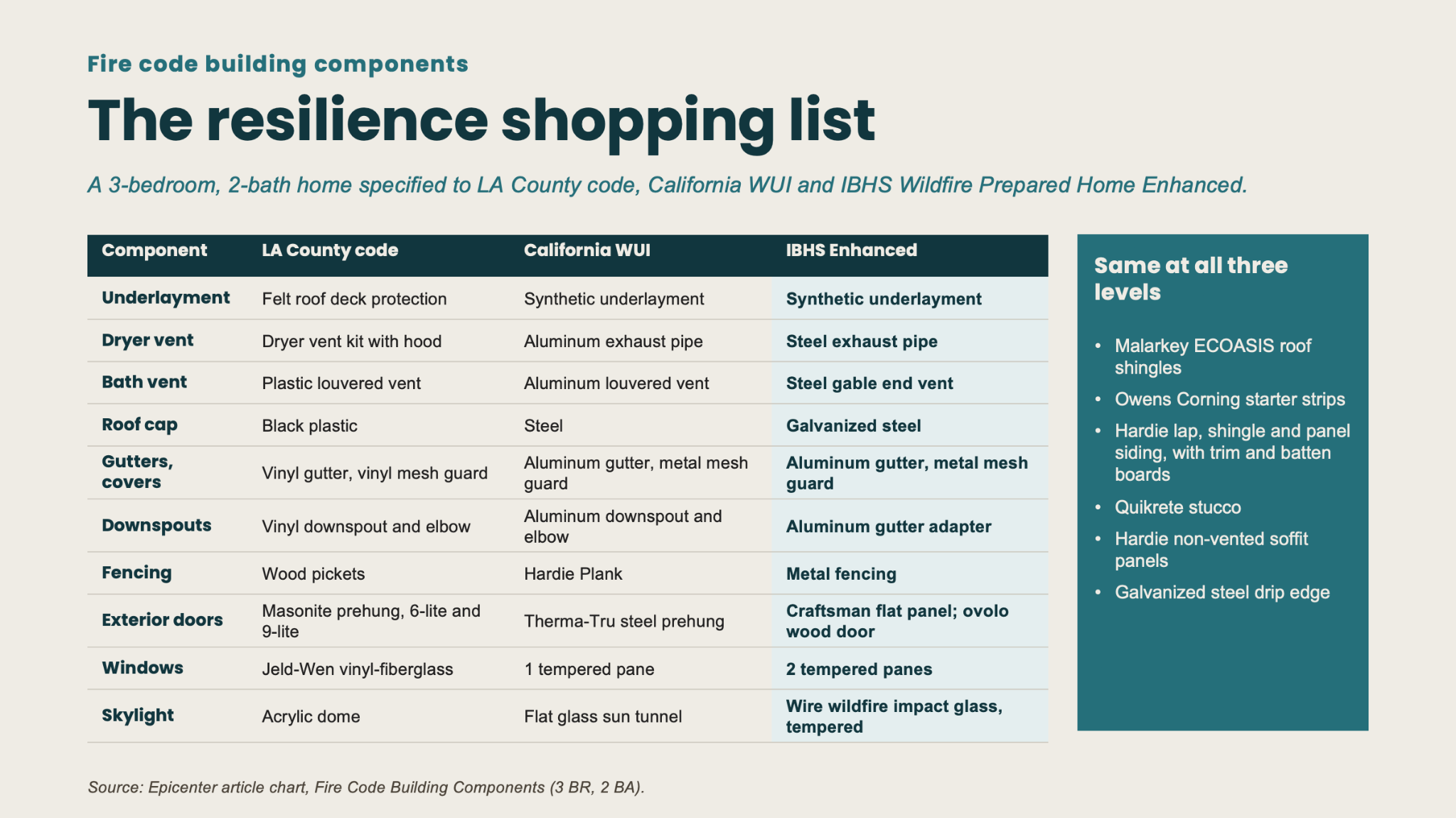
SGV Habitat has spent years building relationships with building material donors. With their contributions, it became possible to lower the all-in cost of upgrading to the Wildfire Prepared Home Enhanced standard by 60-90%. Once donated windows, siding, and roofing were factored in, the pricing gap from standard code to the Wildfire Prepared Home Enhanced standard—the “resilience delta”—came to just 3-5% of total build costs. In some cases, like with “The Lewis” Foothill Catalog floor plan, the donation-adjusted delta was less than $1,500.
Throughout Altadena, SGV Habitat’s cost discipline and donor relationships have made rebuilding to a more resilient standard affordable. The Resiliency Company bridged the remaining gap with small grants.
As its rebuilding pipeline has grown to over thirty homes, SGV Habitat has begun working with outside contractors to keep pace with demand. This has catalyzed a virtuous cycle. The contractors gain experience building to the Wildfire Prepared Home Enhanced standard, which they can then introduce to other communities, improving access to resilient home building.
For its part, The Resiliency Company is exploring how it can take the blueprint developed in Altadena with SGV Habitat and expand it into neighboring jurisdictions across Los Angeles County.
From Pine Street in Altadena to neighborhoods throughout the country, there is a growing ecosystem of builders, insurers, homeowners, and organizations like SGV Habitat and The Resiliency Company that are taking steps to make resilient building the norm.
For more on the resilience shopping list and what it takes to rebuild with resilient materials, check out Resilient Los Angeles, an initiative of The Resiliency Company. Resilient LA published sections of a manual, Rebuilding with Resilience, which outlines the process of designing and rebuilding homes for wildfire-prone environments.
Have thoughts to share on this piece, or want to add your voice to the conversation? Reach out!

From a $600 million storm-resilience bond in St. Petersburg to drainage renewals in coastal Louisiana, Tuesday’s election results show strong local support for well-defined adaptation investments.

Data from the wettest summer in five years reveals three opportunities to invest in resilience.

Alabama’s approach to scaling the FORTIFIED standard has become a blueprint nationwide.

Alabama used five financing levers to get insurers and homeowners to pay for FORTIFIED roofs.