Insights & ideas on resilience straight to your inbox. Were you forwarded this email? → Subscribe here
- Feature: Resilience Pays for Itself Several Times Over. Communities Are Finding Ways to Capture the Return. - From the archive: Cities Face $1 Trillion in Deferred Infrastructure Costs. Building Resilience Requires Pricing That Exposure. - In the news: Who Pays When Flood Risk Is Revealed?
Help Us Improve the Epicenter: A 3-Minute Request
To make The Epicenter more valuable for you, we're conducting an audience survey. It's short—just 3 minutes of your time!
Here’s the Audience Feedback Survey. Your input will go a long way in shaping future content and ensuring The Epicenter delivers value for readers like you.
Resilience Pays for Itself Several Times Over. Communities Are Finding Ways to Capture the Return.
Study after study finds a strong return on investments in resilience. The challenge is that the people who pay for it rarely collect the benefits.
Recent research puts numbers on it:
Every $1 invested in disaster preparation can save $13 in economic costs, damages, and cleanup (U.S. Chamber of Commerce).
Every $1 California invests in hardening homes could return $1.70 in total economic activity (Earth Economics).
The figures vary based on the research methodology and what numbers are included, but they make the same case: it pays to invest in resilience.
To do so, policymakers and investors need to address a fundamental disconnect, according to a new report from the World Economic Forum (WEF) and Marsh, a global professional services firm focused on managing risk. As Addressing Insurability: A Playbook for Investing in Place-Based Resilience puts it, “Those who pay are rarely able to capture the majority of the value they create.”
A better stormwater system can protect thousands of properties and businesses, but no single beneficiary has a strong enough incentive to pay for the whole thing. “The benefits are distributed among homeowners, businesses, insurers, lenders and governments, and accrue over decades, while the costs are concentrated and immediate,” the report said.
WEF and Marsh offer ideas to connect resilience investment more directly with returns, focusing on three action areas:
Make resilience investable by determining how to capture its value: One example is a resilience district, a geographically defined district where a local government invests in climate adaptation and other resilience projects. Within a district, the government can repay resilience projects with the higher property tax revenue those projects help generate. In July 2026, the Resilience District Incubator announced five pilot communities in California and Connecticut that are exploring whether districts like these could help finance long-term resilience investments.
Make resilience attractive for private capital: In California, the Forest Resilience Bond gives investors a clear path to repayment for wildfire prevention. Investors fund forest restoration work upfront, and beneficiaries such as utilities and the state repay them through cost-share payments. In Washington, D.C., property owners who install green infrastructure, like rain gardens and green roofs, can earn stormwater retention credits, which they can sell to developers who need to meet the city’s stormwater rules.
Design insurance for the community: The report highlights a New York City pilot in which a nonprofit, the Center for NYC Neighborhoods, holds a parametric insurance policy on behalf of the neighborhoods it serves. Parametric insurance pays a set amount automatically when a measured trigger is met. In this case, the trigger is flooding above a preset level. When that happens, the Center receives the payout and can quickly deliver grants of up to $15,000 per household.
As Matt Posner, the Head of Public Finance for The Resiliency Company, has argued on The Epicenter: simple is smart when designing the funding mechanisms for resilience. Bespoke resilience finance transactions often struggle to scale because every transaction reinvents its own rules, while broad “green” designations are too vague to measure. The optimal funding mechanisms exist in a middle path that values resilience within the debt instruments we already have.
The Great Unlock | Xavier de Souza Briggs and Matt Posner | How public, private, and philanthropic leaders can scale the next chapter of climate resilience. A national call to action prepared for Chicago Climate Week and Aspen Ideas: Climate.
Climate Change Worsened Coastal Flooding During East Coast Nor’easter | Climate Central | Climate Central found that sea-level rise significantly worsened flooding during last month’s nor’easter, adding roughly six inches of water at some tide stations from South Carolina to Massachusetts.
Juneau Can’t Stop the Floods, But It’s Learning To See Them Coming | Grist | In Juneau, glacial outburst floods have become an annual threat, repeatedly damaging homes along the Mendenhall River. A new online dashboard translates glacier and hydrology data into forecasts residents can use to decide when to sandbag, protect belongings, and evacuate. More than 15,000 people accessed the tool last year.
We Can Measure Climate Resilience. Why Aren’t We Investing in It? | World Economic Forum | This analysis argues that new climate-risk analytics can quantify the financial value of adaptation by modeling avoided losses down to the level of individual assets. The missing piece is an institutional framework to turn those measurements into investment decisions.
Read more about resilient public infrastructure and government solutions on The Epicenter here.
Real Estate & Construction
Good News: State Farm Is Back. Bad News: It’ll Cost You. | CityWatch LA | State Farm is proposing new wildfire underwriting standards that could make insurance available to more California homeowners if their properties meet stringent defensible-space and structure-separation requirements.
Flooded With New Information: Who Pays When Flood Risk Is Revealed? | Resources for the Future | New research finds that when homes are newly identified as being at higher flood risk, their sale prices fall by roughly 2%, while the financial hit is larger relative to income for lower-income homeowners. The research also finds that flood-prone properties are more likely to be sold to higher-income, white buyers. This podcast digs into those findings.
Fight Intensifies Over the Fate of Homes Falling Into the Sea | The Washington Post | In Dana Point, California, homeowners are spending tens of thousands of dollars each to build a rock wall against accelerating beach erosion, even as coastal officials warn that seawalls can worsen erosion and damage the public beaches they are meant to protect.
Read more about resilient real estate on The Epicenter here.
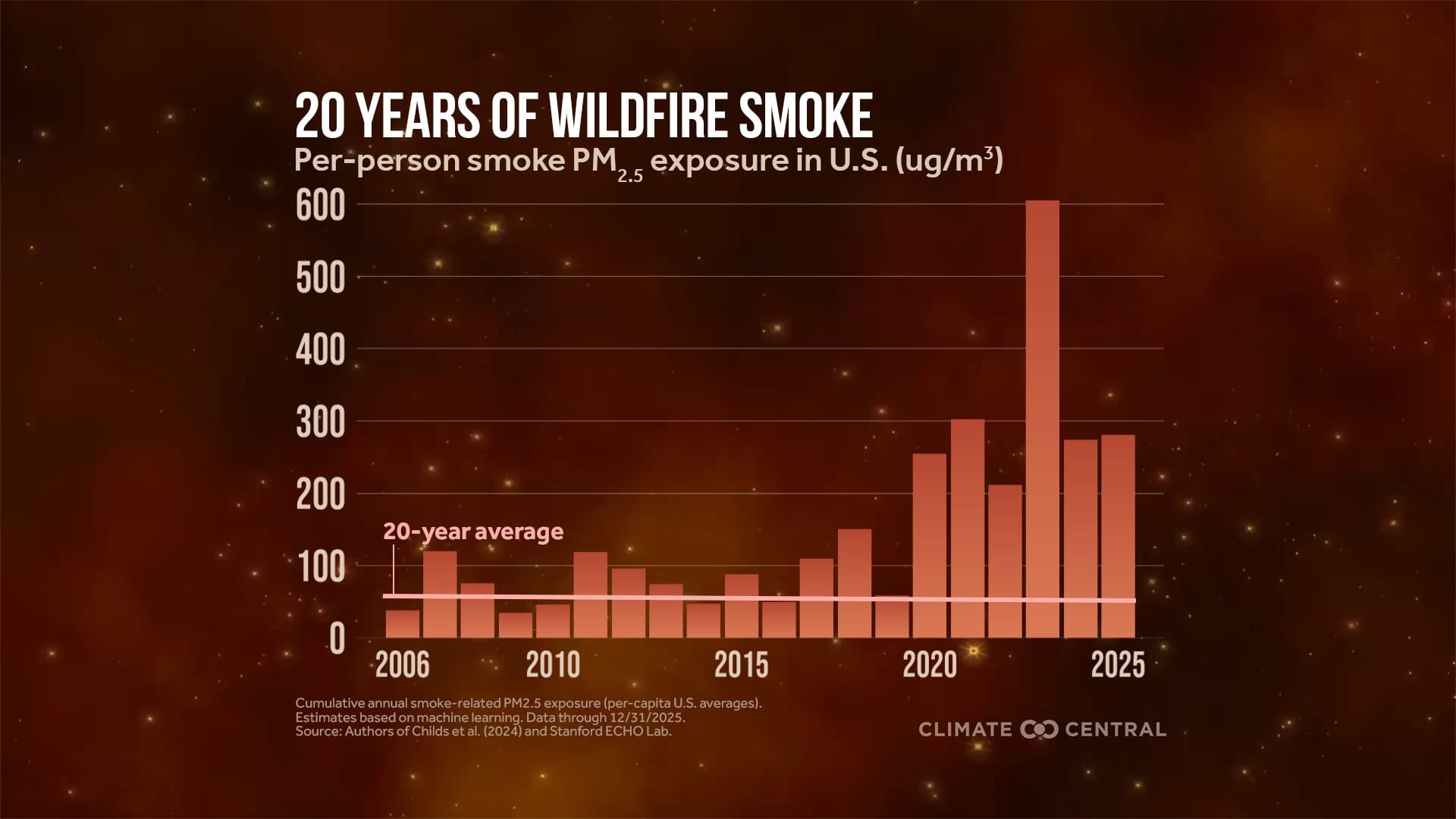
The Chart of the Week
The average person in the U.S. was exposed to four times more smoke PM2.5 during 2020-2025 than during 2006–2019.
Have thoughts to share or want to add your voice to the conversation? Reach out!
The Epicenter helps decision-makers understand climate risks and discover viable resilience solutions. The Epicenter is an affiliated publication of The Resiliency Company, a 501(c)3 nonprofit dedicated to inspiring and empowering humanity to adapt to the accelerating challenges of the next 100+ years.
A new set of case studies and a policy brief lay out how states are financing property-level resilience improvements that reduce disaster losses, improve housing affordability, and stabilize stressed insurance markets.