A new set of case studies and a policy brief lay out how states are financing property-level resilience improvements that reduce disaster losses, improve housing affordability, and stabilize stressed insurance markets.
The Weekly: U.S. Data Shows Resilience Investments Pay Back $1.86 Per Dollar
The economic losses from disasters that are not covered by insurance continue to grow, but resilience projects are generating measurable positive returns.
Insights & ideas on resilience straight to your inbox. Were you forwarded this email? → Subscribe here
- Feature: The economic losses from disasters that are not covered by insurance continue to grow, but resilience projects are generating measurable positive returns. - In the news: Climate change could increase global hail-related damage by as much as 42% by the end of the century. - From the archive: Should wood be a public utility?
New Swiss Re research pegs the global natural catastrophe protection gap, the portion of economic losses from disasters not covered by insurance, at $424 billion in 2025, which is a 7% jump from 2024.
That’s the figure in the headlines, but two other findings in the report tell a more nuanced story: Insurance coverage is growing alongside risk, and U.S. resilience projects are generating measurable positive returns.
Finding #1: Insurance Coverage Is Growing at a Rate in Line With Catastrophe Exposure
Swiss Re’s resilience index, which tracks the share of global catastrophe exposure covered by insurance, rose from 25% to 27% over the past decade. In some markets (like parts of Asia and Germany), coverage is outpacing risk. But the worldwide catastrophe protection gap is still widening in absolute terms, simply because there are more structures in harm’s way. Economic growth continues to add new assets to hazard-exposed areas, and reconstruction costs have increased. When, as the report puts it, “population continues to concentrate in catastrophe-exposed states,” more homes and infrastructure—and more value—are ending up in places that flood and burn. But insurance coverage is growing to meet this increase in construction. According to Swiss Re, “the proportion of protection need covered by insurance was broadly unchanged vs 2024.”
Finding #2: U.S. Resilience Projects Are Generating Nearly $2 in Benefits for Every $1 Spent
A Benefit-Cost Ratio (BCR) compares a project’s expected financial benefits to its expected costs. For resilience projects, the primary benefit is reduced disaster losses. Swiss Re reviewed U.S. projects approved between 2010 and 2022 that disclosed expected benefit-cost ratios, drawing from U.S. Army Corps of Engineers feasibility reports and state and municipal analyses, representing roughly $9 billion in project value.
Every project anticipated positive net returns. The median BCR was 1.86: nearly $2 in anticipated future benefits for every $1 invested. The highest, from a flood-risk-management levee project in New Mexico, was 9.63. Swiss Re notes that these figures likely underrepresent the true returns, since most project appraisals don’t include factors such as life-safety benefits, broader economic effects, and ecosystem services provided by green infrastructure.
This Data Is Making a Strong Case for Resilience
If insurance coverage is broadly keeping pace with exposure growth, expanding coverage alone isn’t the answer. Swiss Re’s research points to a clear prescription: “One way to improve resilience across regions is to reduce expected losses through targeted adaptation projects, which can lower physical vulnerability, support insurability and improve the economics of risk transfer,” it said.
For insurers, municipal officials, and private investors, reports like this one can help justify a shift in how capital is allocated. When a global reinsurer like Swiss Re publishes benefit-cost data showing that every reviewed U.S. resilience project yielded positive net returns, the industry gets another credible, citable foundation for directing capital toward adaptation. The exposure accumulation story embedded in the $424 billion figure sharpens that case further: As it becomes clearer that the protection gap is growing because of where and how we are building, the economic rationale for targeted resilience investment becomes harder to dismiss.
Warmer World Means Bigger Hail and More Damage, Study Finds | Insurance Journal | A new study in Nature projects that climate change could increase global hail-related damage by as much as 42% by the end of the century. The research adds to the growing evidence that larger hailstones, more frequent severe storms, and continued development in exposed areas will create a growing challenge for insurers.
A Look at How Real Estate Insurers Are Responding to Climate Change | Risk & Insurance | This article offers a look at how insurers are becoming active partners in climate resilience. It also collects the perspectives of industry leaders on the state of the market. According to one: “Customers who actively invest in mitigating risk, whether through property hardening or operational improvements, can see that reflected in their overall program.”
California’s Wildfire Season Is Off to an Early Start. What’s Next? | The New York Times | California's wildfire season is already underway, driven by a combination of winter rains that drove early vegetation growth and spring heat. A developing El Niño could complicate the outlook, potentially bringing moisture from Pacific storms while also increasing the risk of lightning-sparked fires. The article explores the complicated climate factors shaping this year's fire season forecast.
Supreme Court’s Limitation on Wetlands Protection Will Make Flooding Worse | Inside Climate News | Wetlands are among the most effective (and often overlooked) forms of natural flood protection. A new study finds that wetland loss has contributed to roughly $10 billion in flood insurance claims over the past four decades, while remaining wetlands provide billions of dollars in flood-mitigation benefits.
Read more about resilient public infrastructure and government solutions on The Epicenter here.
Real Estate & Construction
Future Contractors Learn About Fire-Resilient Construction | Fort Bragg Advocate-News | California's wildfire resilience efforts require a workforce that knows how to put them into practice. In Mendocino County, high school students are learning home-hardening techniques such as ember-resistant vent installation and defensible-space improvements.
Building Resilience: 5 Megatrends Redefining Corporate Real Estate | Colliers | Colliers identifies climate risk as a “megatrend” shaping real estate investment and recommends three priority actions: Make teams more ‘climate-proof,’ identify areas of climate vulnerability, and take advantage of nature-based solutions.
Read more about resilient real estate on The Epicenter here.
Private Investment
How Water Can Scale Climate Adaptation Investment: Lessons From Southeast Asia | World Economic Forum | Floods and droughts are driving losses across the U.S. and the world, yet resilience projects often struggle to attract private capital because their benefits are difficult to convert into predictable cash flows. Drawing examples from Southeast Asia, this article explores how bundling projects, improving impact measurement, and translating resilience into financial value could help unlock investment in water-based resilience.
The Private Capital Opportunity in AI-Enabled Climate and Sustainability Sectors | Boston Consulting Group | A BCG report argues that AI is creating a fast-growing investment frontier where financial returns are aligned with sustainability and resilience. The analysis identifies opportunities in sectors like climate-risk modeling and insurance, grid management, industrial efficiency, and education, estimating more than $600 billion in annual global value by 2028.
Read more about private investment on The Epicenter here.
Should Wood Be a Public Utility? | The Epicenter Editors | Treating wood as a public utility, rather than a waste product, could reduce fire risk, support insurer re-entry, and unlock economic value that currently goes up in smoke.
Beyond Disasters: Home Catalogs as a National Housing Solution | Alexis Pelosi and Robin Keegan | The same principles that accelerate disaster recovery can address housing supply constraints, urban disinvestment, and affordability challenges in any market.
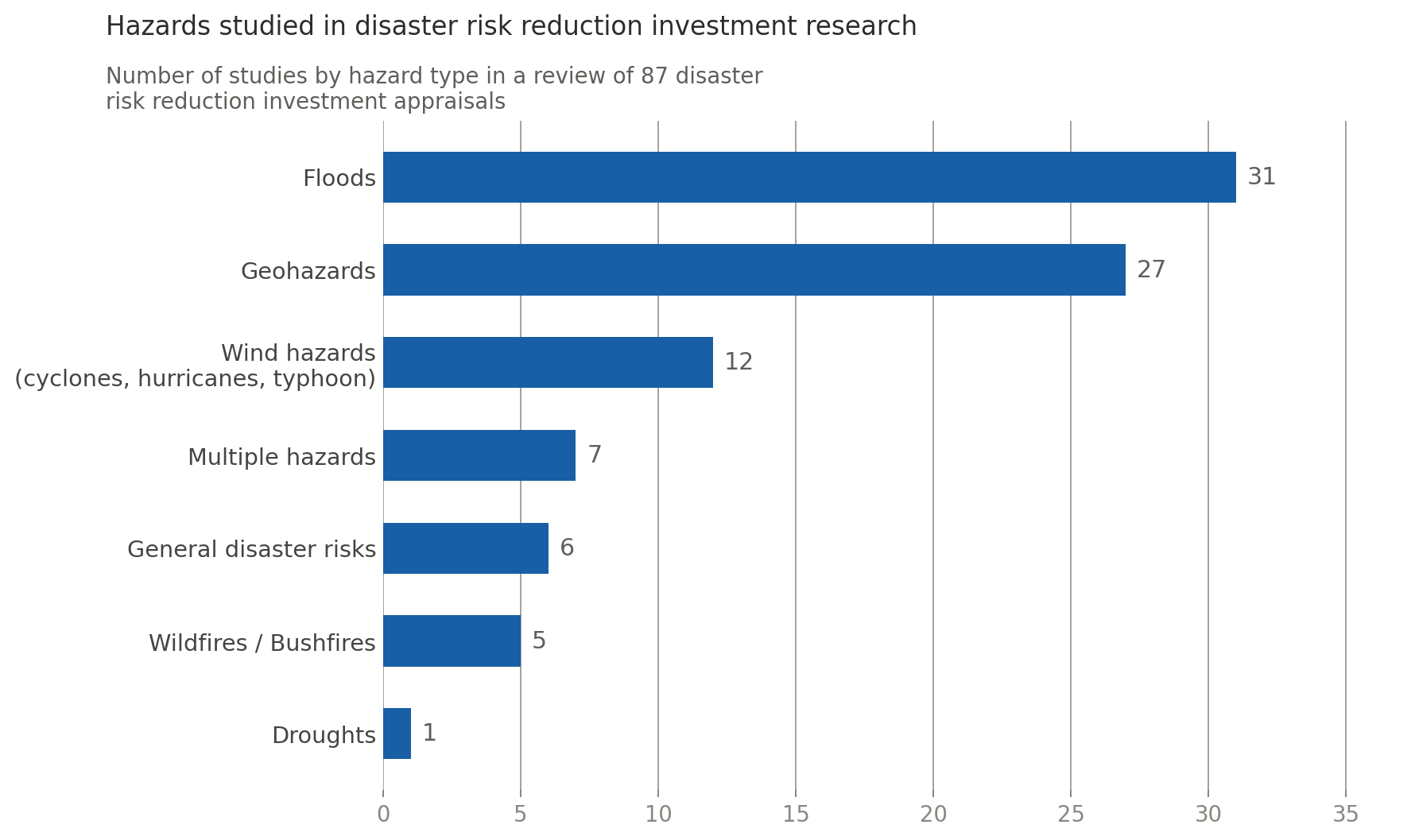
The Chart of the Week
Floods and geohazards, like earthquakes, account for the majority of published research on the value of risk-reduction investments, such as home hardening, green infrastructure, and sea walls, while wildfire resilience remains comparatively understudied.
Have thoughts to share or want to add your voice to the conversation? Reach out!
The Epicenter helps decision makers understand climate risks and discover viable resilience solutions. The Epicenter is an affiliated publication of The Resiliency Company, a 501(c)3 nonprofit dedicated to inspiring and empowering humanity to adapt to the accelerating challenges of the next 100+ years.
A new set of case studies and a policy brief lay out how states are financing property-level resilience improvements that reduce disaster losses, improve housing affordability, and stabilize stressed insurance markets.
Los Angeles isn't short on ideas or expertise. But, like many communities rebuilding after a disaster, it lacks the connections, systems, and capacity to bring them together at scale.